
Like every SaaS founder or CMO, you’re possibly reading this because you want organic traffic that converts to pipeline for your SaaS product, not just pretty charts.
But you may not yet know whether you need an in-house team or a SaaS SEO agency to achieve that.
So, even though you’ve decided SEO is worth investing in, you’re confronted with the question that stumps almost every B2B SaaS company when considering who would handle the practical execution of SEO for their product:
Should we hire an agency or build an in-house team?
Choosing between the two is not a small decision. That’s why getting it wrong will burn a huge portion of your SaaS marketing budget. And when that happens, you not only lose months; you also watch your competitors take the rankings you should own.
On the flip side, SEO becomes your most efficient, compounding growth channel when you get it right.
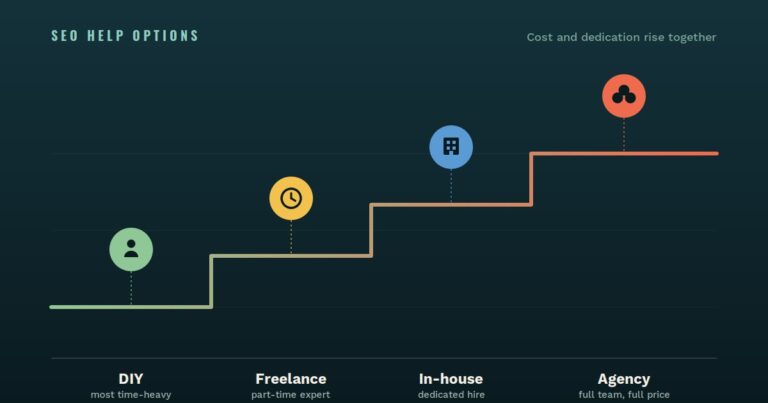
At a glance: Hiring one senior SEO expert can cost $120,000–$180,000 a year. That includes salary, benefits, tools, and other costs. But you’re paying for just one person—not for content, link building, or technical SEO help.
On the other hand, an SEO agency can cost about $5,000–$15,000 a month, which adds up to a similar yearly cost. But unlike the former, you get a whole team— a strategist, writer, technical SEO expert, and link builder. Not just one person.
When comparing the figures for both options, the cost is about the same. The major difference is what you get for your money. That’s why you should follow through on the full breakdown below.
Now, before we continue, note:
This guide breaks down both options clearly so you can make the call that fits your stage, budget, and growth goals.
Why the Decision Matters More in SaaS
SaaS leaders should think carefully before choosing between these options. But first, they need to understand one important thing: SaaS SEO is different from regular SEO.
That distinction hinges on these realities: your buyers often understand technical topics. They also take a long time to decide what to buy. And the words they search for usually describe a problem, not a product.
Here’s the critical part: your content needs to help people at every step—from first learning about the problem to requesting a demo or signing up for a free trial.
That means your SEO team needs to understand your ideal customer, product, competitors, and funnel. Knowing this is critical; it’s not enough to only get more website visitors. What’s the point if those visitors don’t become leads or customers? It’s simple: the traffic doesn’t help your business.
That’s why you should look closely at your SEO strategy, especially if your website traffic is growing without a corresponding increase in your sales.
Here’s the bottom line: the wrong SEO team, in-house or external, costs you more than money. It costs you time you don’t have.
What a SaaS SEO Agency Brings to the Table
Speed and Specialized Expertise
SEO agencies get better by doing the same work many times. So, a good SaaS SEO agency has already learned from past mistakes, tested different strategies, and knows what works for B2B software companies.
An agency can audit your website, identify problems, and start fixing them within weeks instead of months.
The best part is that you get a whole SEO team with one contract. That team can include strategists, writers, technical SEO experts, and link builders.
You don’t have to hire each person, pay their salaries, or manage them. This can be especially helpful when you need to move fast.
For example, if your website traffic suddenly drops, an experienced SEO team can find the problem and start fixing it quickly. They have solved similar problems before. So getting to work right away isn’t a challenge.
Cost Structure
Most SEO agencies charge a set monthly fee, which is often relatively cost-effective for many growing SaaS companies. And that’s because hiring an agency can cost less than building a full SEO team in-house.
That helps your SaaS company save money on salaries, benefits, SEO tools, and the time it takes to manage the team.
Now here’s the catch: don’t decide yet on what is best for you between hiring a SaaS SEO agency and building an in-house team without seeing the full cost breakdown below.
The Gaps You Need to Watch
An SEO agency does not work inside your company. Neither does its team join your product meetings or listen to your sales calls. This distance can make it harder for an agency to understand your product and customers.
But good agencies can fix this by staying in close contact with your team and getting regular feedback.
Unfortunately, that’s not the same experience with weaker agencies. So they may resort to creating generic content that gets visitors but can’t turn them into customers.
Now, another gap to consider when working with an agency is that they have options, meaning they also work with other companies. So your company may not get all of its attention during busy times.
And that can be a problem if SEO is very important to your business right now.
The Real Cost Comparison: In-House vs. Agency
Most comparisons only compare one salary with one retainer, which leaves out the full cost of building an in-house team. In reality, the full math includes base compensation, benefits, tools, and overhead. And remember, all of that only covers one person.
Year-one cost of one senior in-house SEO hire (US market):
| Cost item | Amount |
|---|---|
| Senior SEO Manager base salary (US average, Salary.com, May 2026) | $118,264/year |
| Plus benefits, tools, and overhead | Total rises to $120,000 – $180,000/year |
| Covers | One person only — no content production, link building, or technical SEO support included |
| Effective monthly cost | $10,000 – $15,000/month |
A complete in-house team of three (strategist, content, technical/links) can easily run $400,000 or more per year, using those same per-person estimates. That’s for the team you’d actually need to cover strategy, content, and technical execution — a single hire rarely covers all three.
Compared to an agency retainer:
| Tier | Monthly retainer | Annual equivalent | What you typically get |
|---|---|---|---|
| Startup | $3,000–5,000/mo | $36,000–60,000/yr | Publish 2–4 content pieces monthly, conduct keyword research, and optimize pages |
| Growth | $5,000–12,000/mo | $60,000–144,000/yr | Execute broader SEO, improve technical performance, build links, and track results |
| Full-service / Enterprise | $12,000–27,000+/mo | $144,000–324,000+/yr | Run multi-channel SEO, optimize for GEO/AEO, and provide a dedicated team |
A $10,000- $15,000/month — roughly the same annual cost as one in-house senior hire — a strong agency retainer gets you a full specialist team: strategist, writer, technical SEO, and link builder, not one person wearing every hat.
The timing difference matters as much as the dollar figure. An in-house hire typically needs weeks to months to reach full productivity after joining, on top of however long recruiting takes. An agency retainer usually starts execution in week one, with no recruiting risk if the engagement doesn’t work out.
None of this means agency is automatically the right call — the framework below covers when in-house wins despite the cost gap. But any comparison that skips benefits, tools, and overhead isn’t comparing the real cost of either option.
Source Note
The in-house salary numbers above match the numbers in our SaaS SEO pricing guide, based on Salary.com data from May 2026. This keeps both pages consistent.
The agency price ranges come from published SaaS SEO agency prices collected in September 2026.
Actual prices can change based on location, experience level, and the work you need. So check the latest prices with the agency or recruiter before using these numbers.
What an In-House SEO Team Brings to the Table
Deep Product and Market Knowledge
Nobody knows your product better than the people who live with it every day. An in-house SEO team can extract insights from sales calls, speak directly to customers, and build content in the exact language your buyers use. An internal team also builds institutional knowledge over time — they learn what works and get smarter about your market with every campaign.
Speed of Collaboration
In-house SEOs sit in Slack and in sprint planning. When your product team ships a feature that opens a new keyword category, your SEO person can act on it immediately — hard to replicate with an external agency, and often essential for SaaS companies doing product-led growth.
The Real Challenges
Building in-house takes time and real salary dollars, and a single hire can’t do everything — you need someone who understands technical SEO for SaaS platforms, can build a content strategy, and has the analytical skills to connect keyword research to revenue. Finding one person who does all of that well is genuinely difficult.
There’s also a risk of isolation: an in-house SEO person doesn’t see what’s working across dozens of other SaaS companies the way an agency does, and if they leave, your SEO knowledge walks out the door with them.
The Decision Framework: Which One Is Right for Your Stage?
Early Stage: Seed to Series A
If your company is still small, you may not have enough money to build a full SEO team. At this stage, an agency can give you expert help faster without the cost of hiring several employees. Your job is to look for an agency that knows B2B SaaS companies well.
This is why being clear about what you want from the start is key. For example, you might want SEO to help lower the cost of getting new customers. The idea is to set clear goals and ensure the agency works toward them.
Growth Stage: Series A to Series C
As your company grows, a mix of in-house and outside help can work well. You can hire one strong SEO leader to set the plan, manage the agency, and make sure SEO works closely with your product and sales teams.
The agency can then handle large work, such as creating content and improving pages. When choosing an agency, look for one that is comfortable working as part of a team.
Scale Stage: Series C and Beyond
At this stage, you likely have the budget and org complexity to justify a full in-house team, even if you still use agencies for specific projects like link building or content production at scale.
The point is that your company should keep control of the main SEO plan. That means SEO should work closely with your marketing, product, and sales teams so everyone is working toward the same goals.
How to Check an SEO Agency Before You Hire Them
Before you sign a contract, here are core questions you can ask the agency:
- Have you worked with SaaS companies like ours? Look for an agency that understands companies at your stage, not just one that does general marketing.
- How will you measure success? As you weigh answers, don’t focus only on search rankings and website visitors. Instead, ask how SEO will help bring in good leads and more sales.
- Who will actually work on our account? Sometimes senior experts win the business but hand the daily work to less experienced team members. This is why knowing who will do the work is paramount.
- What will you do during the first 90 days? A good agency should clearly explain its first steps, from getting started to making a plan. But if an agency gives you an unclear answer, that’s a warning sign.
If you want to compare agencies, consult our guide that covers the best SaaS SEO agencies in 2026. And if you’re deciding between SEO and paid ads, check out our guide on SEO vs. PPC for SaaS.
The Mistake Most SaaS Companies Make
Many SaaS companies make this decision once and stick with it forever. But your SEO needs can change as your company grows.
For instance, a startup might need an agency when it’s small, then build an in-house SEO team as it gets bigger. But hiring too soon can also be costly, especially if the new employee still needs help from outside experts to do the job well.
That’s why reviewing your SEO setup every year is important. This involves checking what’s working, reviewing results, and deciding whether to use an agency, build an in-house team, or combine both. Essentially, the goal is to choose the approach that fits where your company is going, not just where it is today.
Bottom Line
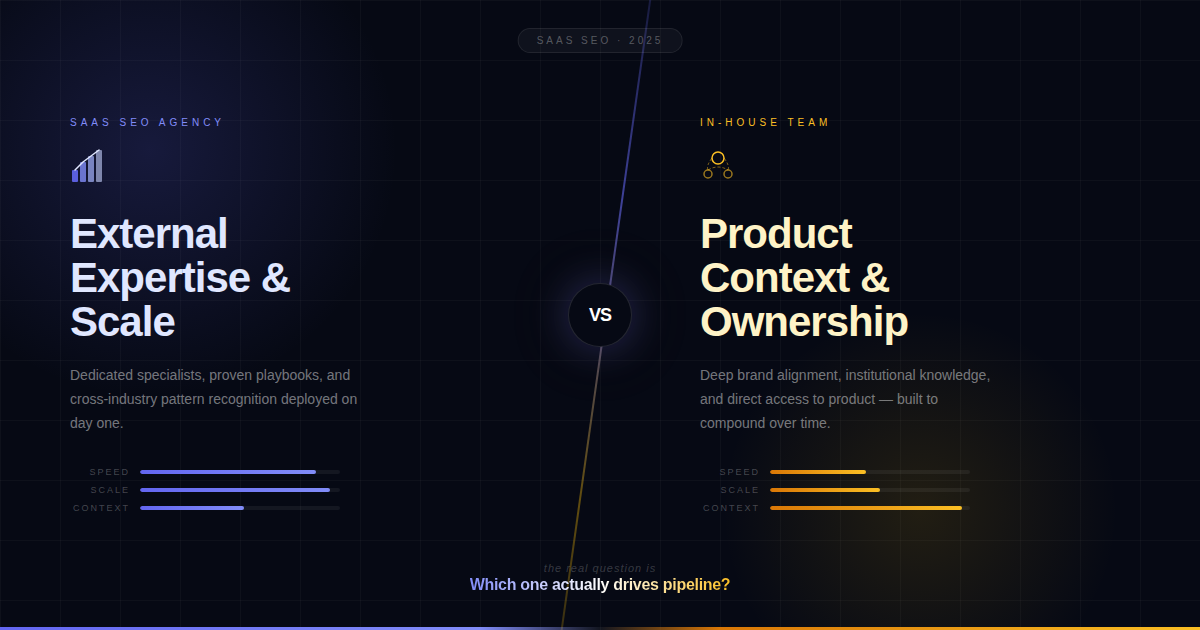
Hiring an agency and building an in-house team are two distinct paths. An agency offers speed, breadth, and expertise without the overhead of hiring. This option is often a third to a tenth of the fully-loaded cost of one in-house hire in year one.
As for the in-house team, it gives you alignment, institutional knowledge, and tight collaboration with your product. But it only makes sense when your company is ready to invest more money upfront and give the team time to get up to speed.
Now, here’s the catch: neither choice is always better. The right choice depends on your company size, how much money you can spend, how important SEO is to your growth, and whether your team can manage an outside team well.
Think of this as part of your overall B2B SaaS SEO strategy from the start. That means treating it as a critical business choice, not just a quick way to get work done.
If an agency aligns with your stage and goals, see our SaaS SEO service to learn how we structure engagements and what they include.