SaaS SEO Services Built to Drive Trials, Demos & Pipeline
SaaS SEO turns organic search into demos, trials, and signups — not just traffic. We build the keyword strategy, technical foundation, and content systems SaaS companies need to convert search visibility into pipeline. Want the full framework first? Read our complete guide to B2B SaaS SEO.
What Is SaaS SEO?
SaaS SEO is a growth strategy that helps software companies attract qualified users through organic search by targeting the right keywords at every stage of the buyer journey. SaaS SEO focuses on search intent rather than chasing traffic volume. It connects your product pages, comparison content, and educational blogs to the specific queries your buyers use when evaluating software.
The goal of SaaS SEO is more than ranking. It is to convert search visibility into demos, free trial signups, and pipeline growth. For the complete 8-step process, learn how SaaS SEO works and what it involves.
SaaS SEO differs from traditional or e-commerce SEO in three key ways:
- Longer buyer journeys: SaaS buyers research, compare, and evaluate before converting. So your SEO must support every stage of that process.
- Product-led intent: Searches often map to specific software features, integrations, and use cases, not just broad topics.
- Pipeline metrics: Success is measured in MQLs, trial signups, and revenue, not pageviews.
Key Takeaways
- SaaS SEO focuses on pipeline growth, not just traffic
- Search intent matters more than keyword volume
- A strong technical foundation supports SaaS scalability
- Topic clusters help build topical authority
- Comparison keywords often drive the highest conversions
- SEO is one of the highest-ROI marketing channels for SaaS companies
What Makes SEO for SaaS Companies Different?
Most SEO strategies are designed around traffic growth, publishing blog content, and broad keyword targeting.
But SaaS companies operate differently. And that’s because SaaS buyers research before purchasing, compare multiple products, and move through long decision cycles.
The point is that SaaS buyers search with clear intent at different stages and evaluate alternatives before converting.
This means that SEO for SaaS companies or startups requires a more structured and conversion-focused approach.
How the SaaS Buyer Journey Impacts SEO
SaaS buyers move through distinct search stages — from problem awareness (“how to automate customer onboarding”) to solution evaluation (“best CRM software”) to head-to-head comparison (“[Product] vs [Competitor]”) — and each stage needs a different kind of page to capture it. We map your keyword strategy to this exact journey. See our guide to SaaS keyword Research to find keywords that drive revenue.
Core Components of a SaaS SEO Strategy
A SaaS SEO strategy that drives pipeline combines five things working together: search intent mapping, buyer-stage keyword research, a technical foundation built for SaaS-specific crawl issues, a content system organized around topical authority, and internal linking that connects it all.
Get the full breakdown of the technical piece in our technical SEO for SaaS guide, and see how we structure everything else in our SaaS SEO strategy framework.
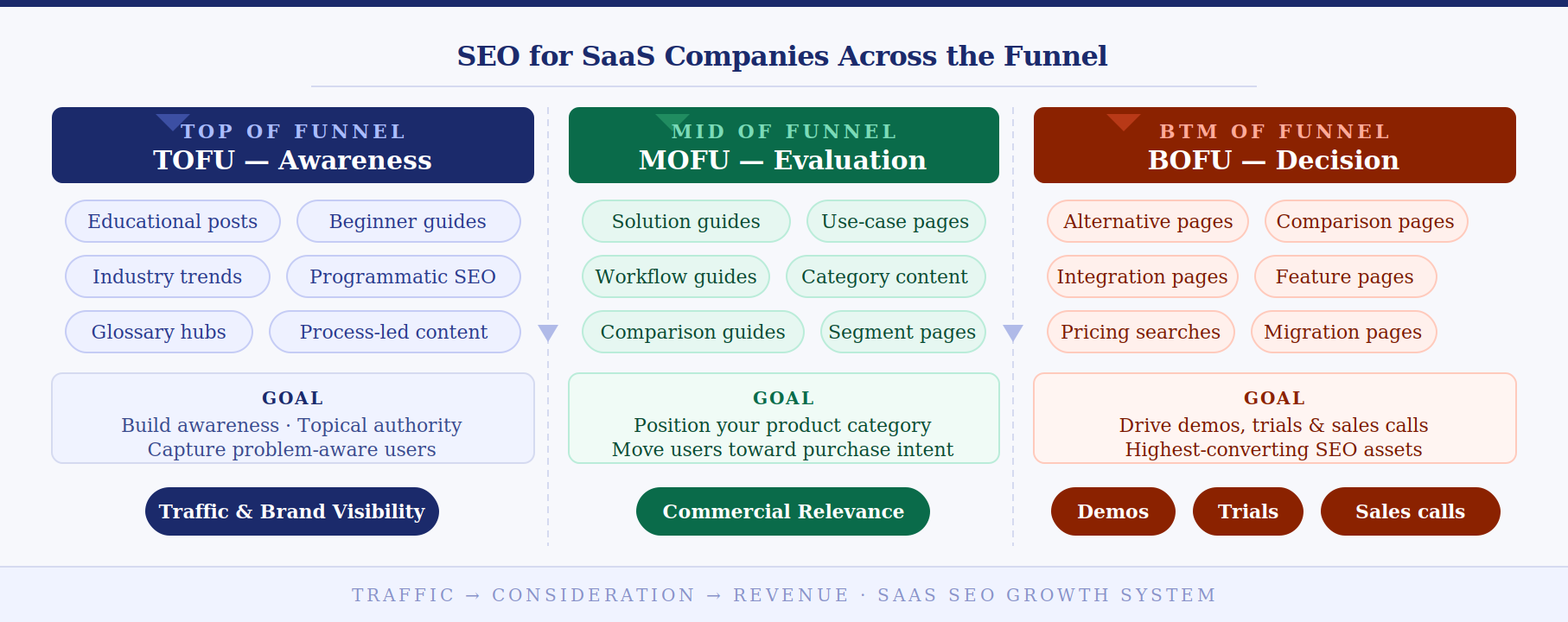
How SEO for SaaS Companies Works Across the Funnel
One of the biggest mistakes SaaS companies make is publishing disconnected content. But what’s the point creating articles that generate traffic but never support conversions? Strong SEO for SaaS companies works like a connected growth system.
TOFU (Top of Funnel)
You attract early-stage users who are just discovering a problem by publishing educational blog posts, beginner guides, industry trends, and “how it works” content.
Your content’s goal at this point is to build awareness, reach problem-aware users, and establish strong topical authority in your niche.
MOFU (Middle of Funnel)
At this stage, you should know that your prospects are are actively comparing solutions and evaluating options.
So your goal is to move them toward purchase intent. And the way to do this is by positioning your product, and building commercial relevance and trust.
In practice, this would mean publishing solution guides, workflows, use-case pages, and comparisons articles.
BOFU (Bottom of Funnel)
At this stage, you convert search traffic into revenue by publishing alternative pages, competitor comparisons, integrations, feature pages, pricing, and migration guides. While these pages drive demos, trials, and sales conversations, many SaaS companies still underinvest despite their highest conversion potential.
High-Intent SaaS SEO Pages That Drive Conversions
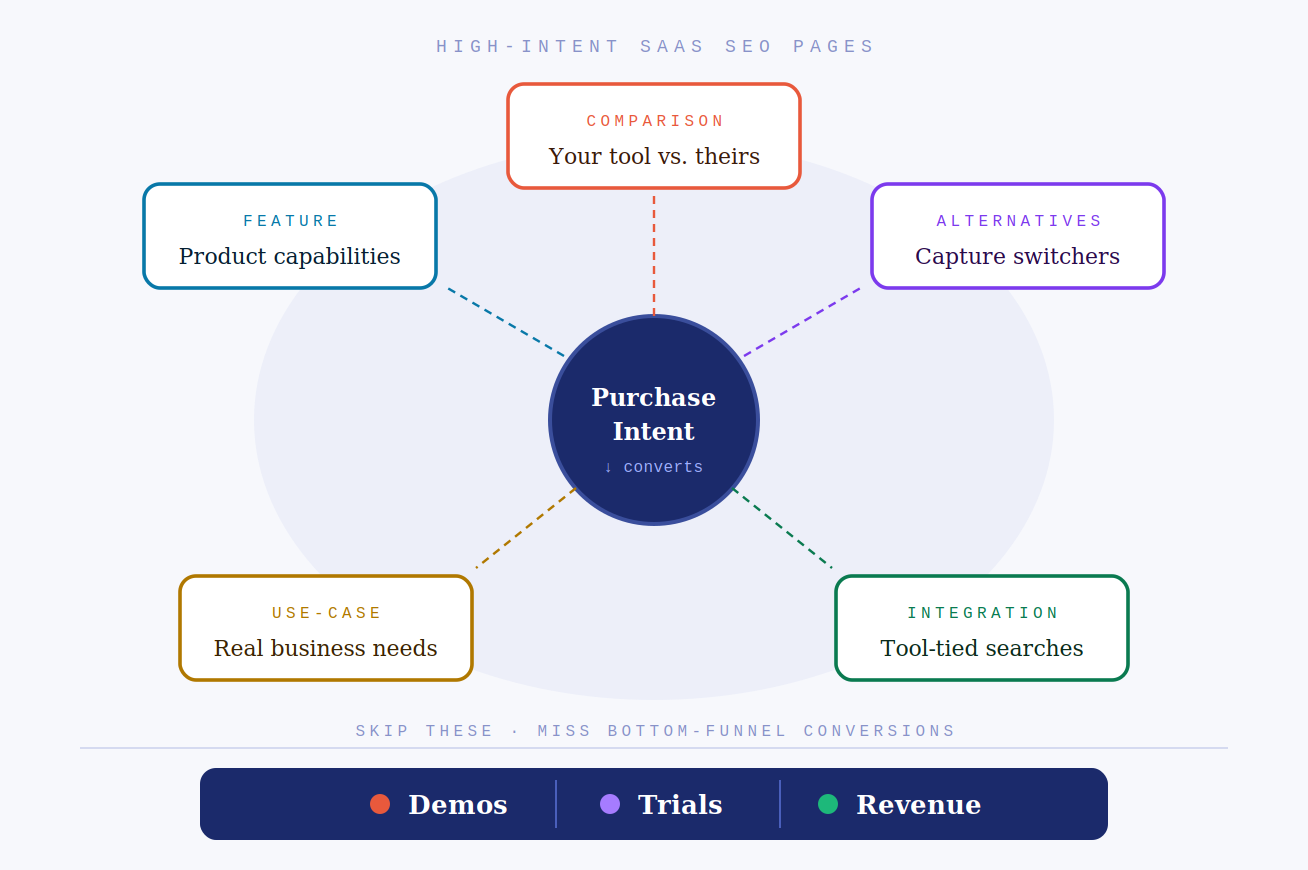
High-intent SaaS SEO pages help you get more demos, free trials, and sales. These are not regular blog posts. They target people who are comparing tools and are ready to choose one.
Most SaaS SEO strategies focus on five main page types:
Comparison pages
Alternative pages
Integration pages
Feature pages
Use-case pages
Comparison pages show how your product stacks up against competitors. Alternative pages target people looking for a replacement for another tool.
Integration pages target people searching for ways to connect your product with other tools they already use.
Feature pages explain what each feature does and why it matters. Use-case pages show how your product solves real business problems.
Companies that rank well for SaaS keywords invest in these pages because they attract buyers who are ready to take action.
Google also ranks these pages because they match the way SaaS buyers search, compare, and make decisions.
Without these pages, you miss valuable bottom-of-the-funnel traffic that can turn into customers.
Product-Led SEO for SaaS Companies
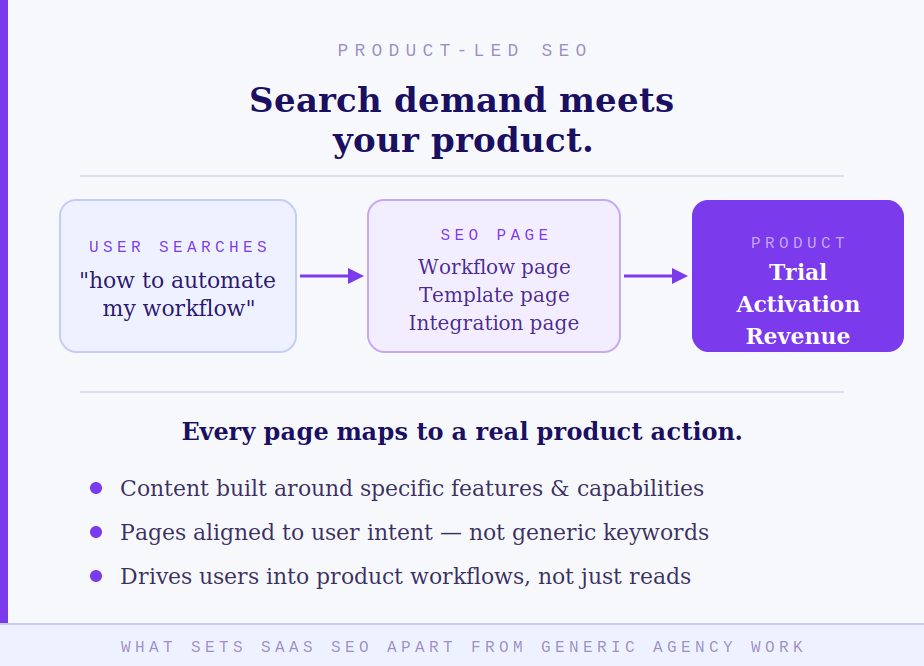
Product-led SEO helps people find your product through search and use it right away.
For a SaaS company, this means creating pages that explain what your product can do.
These pages can include workflow pages that show how to complete a task, template pages that people can use right away, and integration pages that explain how your product works with other tools.
Make sure every page matches what people are searching for and leads them to a real action inside your product.
This approach makes SaaS SEO different from the generic SEO services many agencies offer.
It helps people move from search results into your product, where they can start a free trial, use key features, and become paying customers. To see how the page types, keyword mapping, and execution fit together, read our guide to product-led SEO for SaaS.
The SaaS Content Cluster Strategy We Use
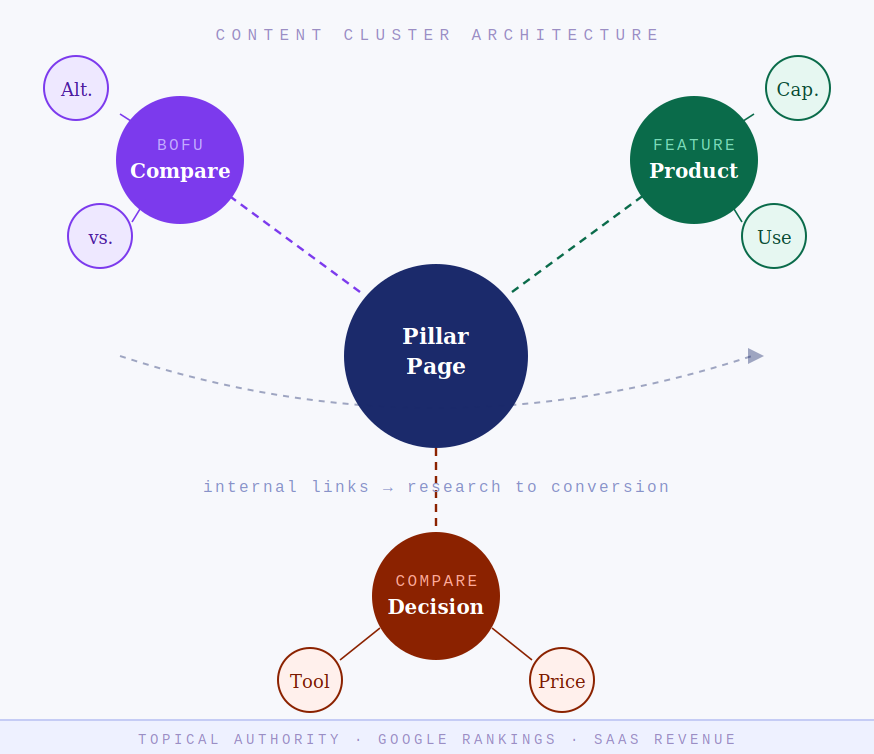
We structure SaaS SEO using pillar pages and supporting content clusters, not standalone posts — BOFU clusters for comparisons and alternatives, feature clusters for product capabilities, and comparison clusters for decision-stage searches. This builds topical authority and keeps every page working together instead of competing for the same rankings. Read how we build the pillar-cluster model.
Why SaaS Companies Struggle With SEO
Many SaaS companies spend time on SEO but get poor results because they:
- Target the wrong keywords
- Publish content without a plan
- Ignore product-led SEO
- Chase broad keywords
A strong SaaS SEO strategy focuses on how people search for software, then creates content that matches their needs.
SEO Strategies Built for B2B Growth
Different industries require different SEO strategies. If your company operates in a specific niche, check out our other specialized services:
Each strategy focuses on how buyers in that industry search for solutions.
Three Core Principles in SaaS SEO
Funnel-Focused SEO
Every keyword, blog post, and landing page is built to move users from trial to paid.
Conversion-First Approach
Traffic is only valuable if it drives action.
SaaS-Savvy Strategy
You need to speak your prospects’ language. That means talking about churn, activation, and MRR. And that’s what effective SaaS SEO does — connecting SEO to the numbers that actually drive business growth.
SaaS Keyword Research & SEO Process
A Growth System Designed Around Your Product

Discovery & Research
This is why we start by identifying what your buyers search for at every stage, not just high-volume terms.
Content That Converts
We create blog posts, product pages, and landing pages that educate, build trust, and drive sign-ups.
Site Health & Performance
We fix crawl issues, improve structure, and boost speed so search engines and users love your site.
What a Strong SaaS SEO System Looks Like
A strong SaaS SEO system combines:
- a healthy technical foundation
- intent-driven keyword research
- structured content strategy
- internal linking architecture
- conversion-focused search targeting
When these systems work together, SaaS SEO becomes a scalable acquisition channel instead of a traffic experiment.
Why SaaS SEO Strategy Differs From Traditional SEO
Here’s how SaaS SEO differs from traditional SEO in practice:
SaaS SEO vs Traditional SEO
| SaaS SEO | Traditional SEO |
|---|---|
| Focuses on pipeline growth | Focuses on traffic growth |
| Targets buying intent | Targets broad keywords |
| Uses structured content systems | Relies heavily on blogs |
| Supports long sales cycles | Often short conversion cycles |
| Prioritizes conversions | Prioritizes visibility |
Why SaaS Companies Invest in SEO
SEO lowers customer acquisition cost, compounds over time, and captures high-intent buyers already evaluating solutions — a channel paid ads can’t replicate once it’s built. See the full CAC and ROI breakdown.
SEO Marketing for SaaS Companies: Organic as a Demand Generation Channel
Unlike paid acquisition, organic search keeps working after you stop paying for it — serving awareness, evaluation, and decision-stage buyers at once, and lowering CAC as it compounds. Read the full breakdown of SaaS SEO’s ROI case.
How We Approach SaaS SEO
We build SaaS SEO systems around buyer intent, product positioning, technical scalability, structured content architecture, and long-term pipeline growth
Our approach combines:
- SaaS SEO strategy
- site architecture and performance
- keyword research
- SEO content systems
- conversion-focused optimization
to help SaaS companies create sustainable organic growth.
👉 Explore our SaaS SEO Services
Common SaaS SEO Mistakes
Many SaaS companies struggle with SEO because they:
Focus only on informational keywords
Publish blog posts without building topic clusters
Ignore site health and crawlability
Chase traffic instead of leads and sales
Learn about the most common SaaS SEO mistakes and how to avoid them.
Frequently Asked Questions About SaaS SEO
How can SaaS companies use SEO to drive more free trial and freemium signups?
The most effective approach combines bottom-funnel content (alternatives pages, competitor comparisons, feature pages) and product-led SEO (integration pages, use-case pages, template content). These pages target users who are already evaluating software and ready to act. And yes, when paired with strong calls-to-action and frictionless trial flows, they convert organic visitors into active users.
How long does SaaS SEO take?
SaaS SEO typically takes 3–6 months to show early traction and 6–12 months to generate a consistent pipeline, depending on competition and execution.
How important is SEO for a SaaS business?
For most SaaS businesses, organic search is one of the highest-ROI marketing channels available. Because SaaS products solve specific, searchable problems, there is almost always qualified search demand to capture. In a nutshell, SEO reduces CAC, generates compounding returns, and builds long-term brand visibility in a way paid channels cannot replicate.
What pages should SaaS companies prioritize?
SaaS companies should prioritize comparison pages, alternatives pages, integration pages, feature pages, and use-case pages because they target high purchase intent.
Ready to Build a SaaS SEO System That Drives Pipeline?
If you’re looking to turn search into a scalable acquisition channel, we can help you build the right SEO system for your SaaS company.