
Most B2B SaaS companies treat SEO like a publishing calendar. And that’s because they pick keywords and ask a writer or content team to cover them, then wait for the traffic to show up.
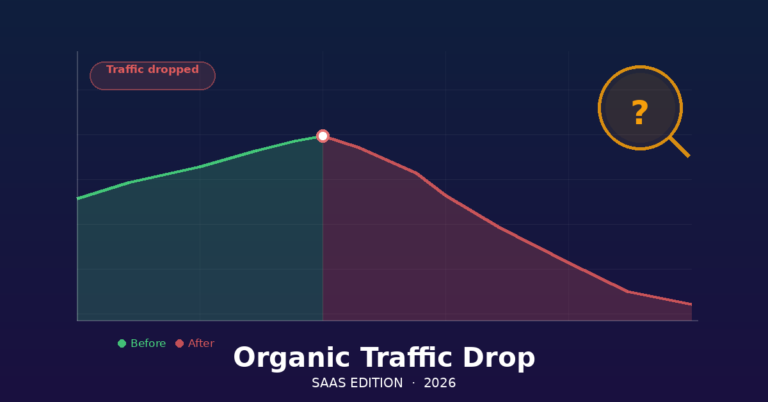
As months go by, traffic grows, but the pipeline stays flat. For most SaaS teams, it is something nobody can explain.
And the reason is that the problem is not effort, but architecture.
The point is that B2B SaaS SEO only works when it runs as a connected system. One that involves keyword strategy, content structure, technical health, and commercial intent — all need to work together.
And the reality is that when one piece is missing, you end up with traffic that does not convert or content that never makes it into the search index at all.
This guide lays out that system in plain language. It is built for B2B SaaS companies that sell to busy decision-makers, face long sales cycles, and need SEO to do more than just generate page views. That said, you can explore our SaaS SEO services.
Here is what you will find in this guide:
- Why most B2B SaaS SEO programs produce traffic but no pipeline
- The four-layer keyword framework that maps to how buyers actually search
- How to build content that grows stronger over time instead of competing against itself
- The technical issues that quietly stop pages from getting indexed
- How to measure SEO results in revenue terms, not just rankings
Why B2B SaaS SEO Is Fundamentally Different From Other SEO
B2B SaaS sits at the crossroads of two things that make search engine optimization harder than almost any other category. The buying cycles are long and complex. And the product itself is often invisible until you fully understand the problem it solves.
That said, you can see our guide on the key differences between B2B SEO and B2C SEO for a broader breakdown of how strategy, intent, and measurement differ across these markets.
But things are different in B2C: someone sees a product, wants it, and buys it in minutes. But in B2B, a buyer has a painful business problem. They spend weeks or months researching it. They compare six or more vendors. They loop in finance, IT, and legal. They negotiate a contract. And then they sign.
This is why SEO has to show up across every stage of that journey, not just the first Google search.
| The average B2B buying cycle involves 6 to 10 decision-makers and spans 3 to 9 months, according to Gartner. Your SEO content is often doing the selling long before your sales team ever gets on a call. |
This reality has three direct effects on how you should build your SEO program.
Keyword volume is a trap.
High-volume keywords in SaaS attract students, job seekers, freelancers, and competitors. But they rarely attract enterprise buyers ready to sign a contract. This is because keywords that actually drive pipeline are lower in volume and much higher in specificity.
Content depth signals trust.
B2B buyers are making decisions that affect their jobs, their teams, and their budgets. So they do not trust shallow content. Instead, they trust the source that helped them understand their problem better than anyone else. This is why depth is not a bonus. It is a requirement.
The content cluster is the unit of authority, not the individual post.
Google does not just evaluate a single page. It evaluates how well your entire site understands a topic. For instance, a site with 20 tightly connected, deeply researched pieces on B2B SaaS SEO will outrank a site with 40 loosely related articles every time.
The Four-Layer Keyword Framework for B2B SaaS
Most SaaS companies do keyword research by opening a tool, sorting by search volume, and targeting whatever looks winnable. But here’s the thing: while that approach produces a lot of traffic, it produces very little pipeline.
The problem is that search volume is a measure of popularity, not buying intent. The terms that get searched the most are usually used by people who are nowhere near a purchase decision.
That said, the four-layer framework below maps keyword types to where your buyer actually sits in their decision process. It is built around intent depth, not volume. You can see this detailed breakdown on saaS keyword strategy for competitive markets for a deeper dive into turning this research into a defensible plan.
| Layer | Intent Type | Buyer Stage | Example Keywords | Goal |
|---|---|---|---|---|
| Layer 1 | Problem-aware | Early research | why is our SaaS churn rate so high” / “signs of product-market fit problems.” | Build trust, earn first visit |
| Layer 2 | Solution-aware | Evaluation | best SaaS onboarding tools” / “HubSpot alternatives for B2B” / “CRM for mid-market sales teams” | Position your category |
| Layer 3 | Product-aware | Comparison | [Your product] vs [Competitor]” / “reviews of [product category]” / “is [product] worth it for enterprise.” | Reduce friction, earn shortlist |
| Layer 4 | Pain-specific | High intent | how to reduce SaaS CAC without increasing ad spend” / “B2B SEO that generates pipeline not traffic” | Convert |
| Most SaaS blogs only target Layers 1 and 2. In reality, Layer 4 is where the buyers who are ready to act live. These keywords rarely show up in keyword tools because the search volumes are too low to register. But every single person searching those terms is a qualified buyer. |
The practical implication: Build your content calendar from the bottom up, not the top down. Start with Layer 4 keywords, which are the exact phrases your best customers use right before they make a buying decision, and then build upward toward awareness.
A fast way to find Layer 4 keywords is to pull your last 30 sales call recordings and listen for the exact phrases prospects used to describe their problem.
Those phrases are your highest-converting keyword targets. And because they are so specific, your competitors are almost certainly not ranking for them yet. This is one of the core reasons SaaS SEO fails to generate leads for so many companies. They target the wrong layer entirely.
How to Structure Content So It Compounds, Not Competes
Content cannibalization is one of the most common and least talked about causes of deindexation in SaaS blogs. It happens when multiple pages on your site target the same search intent. Google picks one winner, ignores the rest, and over time stops crawling the ignored pages altogether.
This is exactly the kind of problem that causes B2B websites to struggle with attracting qualified leads. And it explains why a site may look busy from the outside, even while its pages compete with each other instead of working together.
Many SEO teams think the fix for this issue is to delete content. But it is not. Instead, the best approach is to differentiate their content by intent layer, audience role, and specificity. And then connect the pieces structurally so they make each other stronger.
The Pillar-Cluster Model (Done Correctly)
A pillar page covers a topic at the strategic level. It explains what the topic is, why it matters, and how all the related pieces connect. On the other hand, cluster pages go deeper on individual subtopics. Each cluster page links back to the pillar, the same way the pillar links out to each cluster.
The idea behind the pillar-cluster model is to create a topic web that tells Google two things. First, this site understands this subject at full depth. And second, these pages work as a system, not as competing islands.
| A common mistake: pillar pages that are just a list of links to other articles with one-paragraph summaries of each. That is a table of contents, not a pillar. A real pillar page needs 2,500 to 4,000 words of original, standalone insight. It should be valuable even if the reader never clicks a single internal link. |
How to Differentiate Overlapping Content Without Deleting It
If you have two posts that are targeting a similar intent, here are four clean ways to separate them.
Change the audience angle.
‘SaaS SEO mistakes’ written for a CMO reads very differently from the same topic written for an in-house SEO manager. And that’s because both articles or pieces of content would definitely have different vocabulary, different stakes, and different examples.
So while it’s the same broad topic, they are two completely different articles.
Change the specificity.
This is another interesting way to address two overlapping pieces of content. Take, for example, an article titled ‘Why SaaS SEO does not generate leads’ is different from another titled ‘Why B2B SaaS SEO does not generate leads for enterprise companies with 50-plus-person sales teams.’ And this is because the second has a smaller audience and a much higher conversion rate.
Change the funnel stage.
One article can be awareness-level that explains what the problem is and why it exists. And another can be decision-level that gives the reader exactly how to fix it with templates and a checklist. And the truth is that these two articles serve different “intents” even when the topic overlaps.
Change the format.
Narrative content tends to rank for ‘why’ queries. On the other hand, framework and checklist content tends to rank for ‘how’ queries. That said, the point is that two articles on the same topic in different formats will often rank for different searches without cannibalizing each other.
Technical SEO for B2B SaaS: What Actually Breaks Indexing
SaaS sites face a distinct set of technical SEO problems — dynamic content, user-generated URLs, JavaScript-heavy frontends, and app interfaces that read as content to a developer but as nothing to Googlebot. The five most common causes of deindexation are accidental noindex tags, crawl budget waste from dynamic URLs, JavaScript rendering failures, canonical tag misdirection, and Core Web Vitals failures on content pages.
The truth? Fixing these isn’t optional. If Google can’t crawl and render your pages correctly, none of your content work matters. You can see our guide to technical SEO for SaaS for the full breakdown of each issue, how to catch it, and a complete technical audit checklist.
The Five Technical Issues Most Likely to Cause Deindexation
1. Accidental noindex tags
This is more common than it should be. A developer pushes a change to staging, then copies that environment directly to production. And suddenly, dozens or even hundreds of pages have a noindex instruction sitting in their HTML header.
And you know what? Search engines obey that instruction and drop those pages from the index immediately.
But the question is, how do you fix this? Check your Google Search Console coverage report after every site update, not just once a quarter. The reality is that a noindex tag applied by accident can wipe out months of ranking progress before anyone notices.
2. Crawl budget waste from dynamic URLs
SaaS products often create a unique URL for every user session, filter combination, or sort parameter. And here’s the thing: while those URLs are publicly accessible and not blocked, Google spends its limited crawl budget visiting empty app shells instead of your content pages.
This is why it is good to review your URL structure and ensure all parameterized or session-based URLs are either blocked via robots.txt or pointed at the correct canonical URL. The point is that every crawl request wasted on a dead-end URL is one less visit to a page you actually want indexed.
3. JavaScript rendering failures
If your marketing site is built with React, Next.js, or any other JavaScript framework, Google has to render that JavaScript before it can read your page content. The bottom line is that when rendering fails, which happens more often than most teams know, Google sees a blank page and indexes almost nothing.
A practical way to do this is to use the URL Inspection tool inside Google Search Console to compare the rendered version of your page against what you see in the browser. If they look different, you have a rendering problem that is actively hurting your indexing.
4. Canonical tag misdirection
A canonical tag that points to the wrong URL is an instruction to Google to ignore the current page and give all ranking credit to a different URL instead. This usually happens after site migrations, URL restructures, or when a staging domain accidentally gets set as the canonical source.
This is why it’s important to audit all canonical tags with Screaming Frog any time you change your site architecture. The point is that a single mispointed canonical can quietly remove a page from the index without any error message or warning.
5. Core Web Vitals failures on content pages
Page experience is a confirmed Google ranking signal. This is why if your blog posts load slowly because of unoptimized images, render-blocking scripts, or oversized JavaScript bundles, you will rank below faster competitors even when your content is better written and more thorough.
Check your Core Web Vitals scores in the Experience section of Google Search Console. The idea is to prioritize any pages sitting in the Poor category for speed improvements before you invest further in new content for those pages.
Quick Technical Audit Checklist
Run this after every major site change and at least once every 90 days.
- Search Console coverage report: have any pages moved from indexed to crawled but not indexed?
- Screaming Frog crawl: are any pages returning a noindex tag that should be indexable?
- URL Inspection on five key content pages: does the rendered HTML match what you see in your browser?
- Canonical tag audit: does every page canonicalize to itself or to the correct URL?
- Core Web Vitals: are any content pages in the Poor bucket?
- Sitemap: is it up to date and submitted in the Search Console?
- Robots.txt: are any content directories accidentally blocked from crawling?
The Content-to-Pipeline Connection: Measuring What Actually Matters
The most common reason B2B SaaS SEO programs lose executive support is that they report on the wrong numbers. Traffic and rankings are easy to see. It is unlike pipeline contributions, which is harder to track. Hence, it is the reason most teams never track it.
That creates a slow-moving problem. The truth is that when SEO is measured only on traffic, the program optimizes for traffic. As a result, high-volume, low-intent keywords get targeted because they move the metric.
But the reality is that content gets produced to rank, not to convert. And six months later, leadership is asking why all the SEO investment has not moved the revenue number.
This is also one of the core reasons SaaS companies see organic traffic drops even after months of consistent publishing. They are measuring the wrong thing and making decisions based on misleading data.
The Four Metrics That Actually Tell You If Your SEO Is Working
1. Organic pipeline influenced
How many deals in your CRM touched an organic content page before the first sales conversation? This requires proper UTM tracking and CRM integration, but it is the single most important number for proving SEO value to anyone in leadership. It connects organic search directly to closed revenue.
2. Organic-sourced MQLs
How many marketing-qualified leads per month come from organic search? Track this separately from every other source. The point is that if this number is flat or falling even as traffic grows, your content is attracting the wrong audience regardless of what your session counts show.
3. Content-to-trial or content-to-demo conversion rate
For pages that are supposed to drive bottom-of-funnel action, what percentage of organic visitors take the next step? Take for example, a 0.5 percent conversion rate on a high-intent page is a CTA problem. But a 0.01 percent conversion rate is almost always a keyword targeting problem. These need different fixes since they are diagnosed differently.
4. Customer acquisition cost from organic vs. paid
Calculate CAC separately for organic-sourced customers and paid-sourced customers. In most B2B SaaS companies, organic CAC drops to 60 to 80 percent below paid CAC after the first 12 months of consistent investment.
This is the number that unlocks more SEO budget, because it speaks the language of finance, not marketing. It is also why reducing SaaS CAC through SEO is one of the strongest business cases you can make for this channel.
| Benchmark: mature B2B SaaS SEO programs typically see organic CAC reach parity with paid CAC at the 9 to 12 month mark, and drop well below it by month 18. If you are past that window and organic CAC is still higher, the problem is almost always keyword targeting, not execution quality. |
How to Build Your B2B SaaS SEO System: A Sequenced Roadmap
Most SEO programs fail not because of bad tactics but because they run all the tactics at once without a sequence. Content gets produced before technical issues are fixed. Pillar pages go live before any cluster depth exists to support them. And link building starts before there is anything worth linking to.
The order matters as much as the work itself. Here is the sequence that works.
Months 1 to 2: Foundation
- Run a full technical audit and fix all crawlability issues before writing a single new piece of content.
- Build or verify your keyword map across all four intent layers
- Identify your two or three core content pillars, which are the topic areas you want to be the clear authority on
- Audit existing content for cannibalization and differentiate any pages that are competing with each other. Review common SaaS SEO mistakes that show up at this stage so you can avoid repeating them.
Months 3 to 5: Content Architecture
- Publish or rewrite your pillar pages to full depth, aiming for 3,000 or more words of original frameworks with no thin link lists. If you need hands-on help building out this content layer, our SaaS content strategy and creation service covers research, writing, and publishing end-to-end.
- Build out cluster content for each pillar and target Layer 3 and Layer 4 keywords first, not last
- Establish consistent internal linking between every cluster article and its pillar page
- Add schema markup to all key content pages so Google can better understand the structure
Months 6 to 9: Authority Building
- Begin earning editorial backlinks through original research, expert contributions, and proprietary data assets
- Build product-led SEO pages including use-case pages, integration pages, free tools, and public templates
- Start tracking organic pipeline contribution inside your CRM so you have real data to show leadership
- Identify any content that has dropped in rankings since publication and prioritize it for a refresh
Months 10 to 18: Compounding
- Expand into adjacent topic clusters based on what is actually converting, not what has the highest search volume
- Run a quarterly content audit and update, merge, or redirect underperforming pages based on real data
- Use organic performance data to sharpen your paid strategy as well, since what converts organically tends to convert in paid channels too
- Report SEO results to leadership in pipeline terms, not in traffic terms
The Deeper Resources in This Hub
Each section above links to a more detailed piece that goes into greater depth on that specific part of the system. These are the cluster articles that cover each component in full.
- Your SaaS SEO Is Generating Traffic But Zero Pipeline — Here’s Why — the full diagnostic breakdown of traffic-without-pipeline, including how to identify which layer you are targeting wrong and what to do about it
- How to reduce SaaS CAC with SEO — the financial case for organic search as a cost reduction strategy, with CAC calculation examples and a comparison to paid channel costs
- Why your organic traffic dropped — a step-by-step breakdown of what causes SaaS traffic to fall, from algorithm changes to cannibalization to technical issues
- Common B2B SEO mistakes killing your pipeline — the strategic errors that CMOs and founders make at the program level, and what to do instead
- Content hubs vs scattered content — how to structure your content so that individual articles reinforce each other instead of competing for the same rankings
- B2B SEO vs B2C SEO: key differences explained — a side-by-side breakdown of how keyword strategy, content structure, and measurement differ between B2B and B2C, with real examples
- How to build a SaaS SEO strategy step-by-step — the practical 8-step framework covering audit, ICP mapping, keyword research, content architecture, on-page optimization, authority building, and measurement.
- Technical SEO for SaaS — the complete breakdown of crawlability, site architecture, page speed, indexability, URL structure, structured data, and mobile optimization, with a prioritization framework for fixing issues in the right order.
Final Thought
B2B SaaS SEO done right is not a content factory. It is an architectural decision.
This is why companies that win in organic search over the next three years will not be the ones that publish the most content. They will be the ones that built the clearest topic authority, connected that authority to the exact language their buyers use when they are close to a decision, and measured the results in pipeline rather than page views.
That architecture starts with the foundations covered in this guide. But the rest of the system lives in the cluster articles linked above.
If you want a direct assessment of where your current SEO program stands relative to this framework, check our SaaS SEO service.