
You finally launched a blog, published content, and waited to see the ROI. But only to notice that leads never came. This can be frustrating for B2B SaaS teams, but if you dig deep, there are SaaS SEO mistakes you can point to as the culprits.
| Are you a founder or CMO looking at this from a strategic level? This article is written for SEO practitioners and content managers handling day-to-day execution. If you want the strategic diagnostic — the structural mistakes that kill pipeline at the program level — read this instead: B2B SEO Mistakes That Kill Pipeline → |
Now, if you are a B2B founder or CMO, this story most likely sounds familiar. And yes, you can relate to what it feels like to invest time and budget in SEO, and then the results feel invisible. Traffic may trickle in, but the pipeline stays flat.
You know what? This is why most SaaS founders start to wonder if SEO even works for SaaS companies.
Still, the truth is that SEO does work. But the issue is that most SaaS companies make the same core SaaS SEO mistakes that quietly destroy results before they ever compound.
Interestingly, that’s what I’ll cover in this article. You’ll clearly understand SaaS SEO mistakes, why each one hurts, and learn what you can do to resolve them.
The popular mistakes wrecking the SEO efforts and investments of most SaaS companies include:
Mistake 1: Targeting Keywords That Attract the Wrong People
Most SaaS teams go after high-volume keywords without asking a simple question: Will this person ever buy?
Take, for instance, a keyword like “project management tips” gets thousands of searches per month. But reality is that the people searching for that phrase are mostly students, freelancers, and curious readers. This is because a typical operations director at a 200-person B2B company who needs your software seldom makes such queries.
You see why this is one of the most common SaaS SEO mistakes. Yet the thrilling thing about this mistake is that it is one of the costliest. Imagine spending months ranking for a keyword, but while traffic climbs, nothing converts.
That can be frustrating. But the problem behind this frustrating experience is not your landing page. It’s the fact that you attracted the wrong audience from the start.
How to resolve this Mistake?
Now that you know the real culprit, what should you (or your SaaS team) do?
It’s simple. You should target keywords that signal buying intent or business pain. Typical examples of these phrases include “CRM software for sales teams,” “automate client onboarding SaaS,” or “project management tool for agencies.”
Queries like these pull in people with a specific problem and the authority to solve it. And while these keywords usually have lower search volume, they drive the pipeline. Interestingly, that is the metric that actually matters.
With that in mind, if you want a structured approach to finding keywords that generate revenue (beyond just clicks), you need to understand how intent-based keyword research drives the pipeline for B2B SaaS differently from traditional keyword strategies.
Remember, this fact: “Volume without intent is noise.”
Mistake 2: Writing Content for Algorithms Instead of Buyers
Over the years, search engines like Google have gotten very good at understanding what people actually need. This is why if you stuff your content with keywords but do not answer a real question clearly, it will not rank. And the worst? It will not convert.
Now, here is the bigger problem: many SaaS companies write content for “awareness” that never moves the reader toward a decision.
Simply put, they publish blog posts that explain broad concepts without ever connecting those concepts to the reader’s specific pain, their industry, or the solution your product offers.
In practice, content that does not convert is not just a missed opportunity. Essentially, it is a signal to Google that your page is not satisfying searchers. And guess what? That hurts your rankings over time.
How to resolve this Mistake?
Now the big question is: what should you do instead as a practical measure to address this mistake?
First, you should recognize the significance of mapping every piece of content to a stage in the buyer journey. To do this, start by asking this question:
Is this person (your reader(s)) just learning about a problem, or are they actively looking for a solution?
Once you’ve answered that question, you can then write accordingly.
Often, for bottom-of-funnel content, it’s essential to include specifics. Essentially, in content that falls into this category, you can talk about use cases, mention integrations, discuss pricing ranges, and compare alternatives.
With that in mind, note that if your content feels like it could belong to any company in any industry, it is too vague to drive action. So the reason B2B SaaS content often fails to generate leads is not a lack of content volume but a lack of specificity and intent alignment.
Mistake 3: Ignoring Technical SEO Until It Is Too Late
You can write excellent content and still rank nowhere if your website has technical problems. The reality is that many SaaS companies skip technical SEO because it feels like a developer problem, not a marketing problem. But this philosophy in itself is a mistake.
That said, common technical issues that kill SaaS SEO performance include:
Slow page speed. Most SaaS platforms often carry heavy JavaScript frameworks that slow down load times. And this is not a good thing because Google uses page speed as a ranking factor. As a rule of thumb, a page that takes four seconds to load loses traffic before it even has a chance to rank.
Crawl errors and orphan pages. This is a technical error that most SaaS providers pay the least attention to. But the reality is that if your site has pages that Google cannot reach or pages that have no internal links pointing to them, those pages will not rank. Period.
Duplicate content from subdomains. Many SaaS products run their marketing site on one domain and their app on a subdomain. While this is not an issue in itself, the reality is that if you don’t set up canonical tags correctly, Google may index your app pages, flag duplicate content, or get confused about which pages to rank.
Poor URL structure. URLs like yoursite.com/page?id=2847 tell neither Google nor users anything. This is often the case when your website is set to the default permalink structure on CMS like WordPress. That said, the idea is to use clear, crawlable, and rankable URLs like this: “yoursite.com/blog/saas-onboarding-checklis.”
Now, what’s the practical step to resolve this issue?
A good start would be to run a technical audit at least once per quarter using SEO tools like SEMrush or Ahrefs. This way, you can identify and fix crawl errors and set up proper canonical tags. Beyond that, other practical measures include compressing images and minimizing JavaScript where possible.
Meanwhile, note that internal linking also matters here. For instance, if a new blog post has no links pointing to it from other pages on your site, Google will find it slowly and rank it even more slowly.
That being said, for a deeper breakdown of what belongs in a technical audit for software companies, technical SEO for SaaS companies covers the specific issues that affect product-led platforms differently from traditional websites.
Mistake 4: Treating Every Page the Same
Among the common SaaS SEO mistakes, this is the one that amplifies the reality that not all pages on your site serve the same purpose. This is why you should not try to optimize them the same way.
For example, your homepage competes for branded terms and first impressions. Your feature pages compete for product-specific keywords. More importantly, your blog competes for informational queries, while your comparison pages compete for buyers who are evaluating options. Each of these page types needs a different approach.
One of the most common SaaS SEO mistakes is applying a one-size-fits-all content template to every page. You know what? This will result in a situation whereby your feature pages read like blog posts and blog posts sound like product brochures.
With this in mind, what should you do to resolve this?
The first thing to do is to define the job each page needs to do before you write a single word. For instance, a feature page should answer “what does this do and why does it matter to me?”
On the other hand, comparison pages should answer “Why is this better than the alternative I am already considering?” And then, blog posts should answer the specific question a buyer types into Google at a specific stage of their journey.
You know what? This kind of structured thinking is part of what separates a scattered content calendar from a content strategy that actually drives the pipeline.
Mistake 5: Building Content Without a Topic Authority Plan
Google does not just rank individual pages. It evaluates the overall authority of your site on a given topic. For instance, if you publish one article on customer onboarding and twenty articles that revolve around general productivity, you look like a generalist in the eyes of Google. And guess what? Generalists do not rank well for competitive SaaS keywords.
This is why topic clusters matter. A pillar page covers a broad topic in depth, whereas cluster pages cover specific sub-topics and link back to the pillar. You know what? A structure like this often signals Google that a site is a serious source of information on a specific subject.
To this end, it’s safe to say that without the structure a topic cluster provides, you are most likely publishing content that competes with itself. And often, such pieces of content dilute your authority and confuse search engines about what you actually specialize in.
The next big question is, how do you address this issue?
As already mentioned, it’s paramount that you build your content around one central pillar topic and a set of cluster pages, each of which explains a specific problem or question within that topic. The idea is to ensure every cluster page links naturally to the pillar, even as the pillar links out to them.
This is not just an SEO tactic. Essentially, this is how serious buyers consume content. Imagine a CMO researching SEO for her SaaS company. She will read one article, click through to a related one, and gradually build trust in a source that seems to know its subject deeply. Guess what? That trust turns into demo requests.
Now the interesting part is that the entire approach to building structured knowledge in your niche is laid out in detail in a complete guide to SEO for B2B SaaS companies.
Mistake 6: Neglecting Product-Led SEO Opportunities
Most SaaS companies think of SEO as a blog strategy; one that involves writing articles, ranking for keywords, and driving traffic. While all that is part of a valid approach, blogs (in themselves) miss a huge opportunity when they live outside the product itself.
But that’s where product-led SEO comes in. Essentially, this approach to SEO involves building features, tools, or pages into your product that are inherently discoverable through search. Typical examples include public user profiles, shareable templates, embeddable widgets, free tools, and community-generated content.
The bottom line?
Each new user drives new search traffic when they create content inside your product that becomes publicly indexed.
Interestingly, this is how companies like Canva, Notion, and Airtable grew massive organic audiences without writing thousands of blog posts.
In practice, if your SaaS platform creates any kind of user-generated or shareable output, you may already have the raw material for this strategy. The point is that you have not set it up yet.
Now here’s the real question:
What do you do to take advantage of product-led SEO opportunities?
The first practical step is to audit your product for shareable content. And yes, here’s a good question to ask: what does a user create inside our platform that might be useful to someone outside it?
Once that question is answered, the goal is to make those outputs public and indexable. For instance, you can build free tools that answer a question your buyers are already searching for. Also, you can embed sharing into the product workflow.
In the end, understanding how product-led SEO works for SaaS is worth exploring if you have a product with any public-facing output or free-tier features.
Mistake 7: Running SEO and Paid in Silos
Many SaaS teams treat SEO and paid search as separate channels with separate budgets, goals, and teams. Unfortunately, this is a structural mistake that costs you money and growth.
And that’s because SEO and paid search actually inform each other. The thrilling fact about paid search data is that it tells you which keywords convert beyond clicks.
For instance, if a keyword drives paid conversions, that is a signal to prioritize it in your organic strategy. On the flip side, if you rank organically for a high-converting keyword, you can reduce paid spend on that term and redirect budget elsewhere.
The point is that when these two channels do not work hand in hand, you end up bidding on keywords you already rank for. Or worse, you invest months into organic ranking for keywords that paid search data has already proven do not convert.
With this in mind, what should you do instead for your SaaS company?
You can start by sharing conversion data between your SEO and paid teams.
That said, if you are deciding how to allocate your acquisition budget, then understanding the structural differences between SEO and paid search for SaaS is paramount. It helps you make that call based on data, not assumptions.
Mistake 8: Outsourcing SEO Without a Clear Brief
Many B2B founders and CMOs hire an agency to fix their SEO. And as expected, they hand over access credentials (to them) and wait for results. And six months later, they have many new blog posts and very little pipeline growth.
Now, you may think that the problem is always with the agency, but that’s not the case. Often, the problem is that the company did not define what success looks like, did not stay involved in strategy decisions, and hired an agency that specializes in the wrong kind of SEO.
In truth, SEO for SaaS is not the same as SEO for e-commerce or local businesses. For instance, an agency that built its reputation ranking law firm websites is probably not the right fit for a B2B SaaS platform targeting enterprise buyers.
As a SaaS company, what should you do instead?
It’s simple. Before you hire anyone, get clear on your goals. Do you want more organic traffic? More qualified leads? Better rankings for specific competitor comparison terms?
Of course, these different goals require different strategies.
Thus, if you are evaluating whether to hire an agency or build an in-house team, it’s pertinent to understand the real trade-offs between an SEO agency and an in-house hire before you commit.
That said, the truth is that if you decide to go the agency route, it’s crucial to know how to evaluate and choose the right SEO agency for SaaS. This will save you a lot of wasted budget.
Mistake 9: Measuring Traffic Instead of Pipeline
This is the most damaging SaaS SEO mistake of all. And the unfortunate thing is that it is usually invisible until it is too late.
Just imagine you are measuring success by traffic. In this case, you assume SEO is working if traffic goes up. When in reality, your pipeline stays flat… Revenue from organic stays flat. And the more disheartening part is that the customer acquisition cost from organic stays flat or even worsens.
The point is that traffic is a vanity metric when it is not connected to qualified visitors. For example, 10,000 monthly visitors from blog posts about generic productivity topics will not move your revenue numbers. But two thousand monthly visitors from high-intent SaaS buyers will.
The bottom line? If your SEO is driving a lot of traffic but your customer acquisition cost remains stubbornly high and organic conversions are weak, then the traffic volume is not the problem you need to solve. Instead, your audience targeting and content intent are.
Now the big question:
What can you do instead to address this mistake?
A good start would be to redefine your SEO success metrics. That would mean tracking organic leads, organic demo requests, organic MQLs, and organic pipeline value. And yes, if your analytics setup does not capture these, then you need to fix that first. The reality is that you cannot optimize what you cannot see.
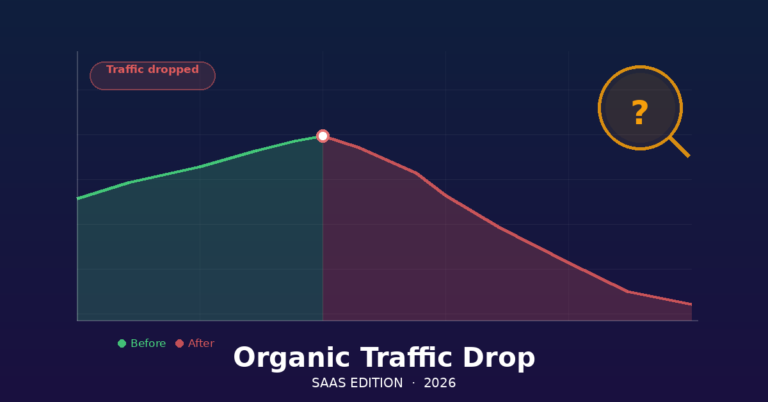
The truth? If your organic traffic has dropped recently, the problem is often one of several technical or strategic issues specific to software companies, not general websites. This is why understanding why organic traffic drops for SaaS companies is usually the starting point for a meaningful recovery.
The Bottom Line
It’s easy to think SaaS SEO mistakes are random. But they are not; they follow patterns. As mentioned already, most companies target the wrong keywords, write content without intent, skip technical foundations, and measure the wrong outcomes.
The good news? None of these problems is hard to fix once you can see them clearly. But they do require a systematic approach. And yes, you need a keyword strategy tied to buyer intent, a content structure built around topic authority, clean technical foundations, and metrics that connect organic search to revenue.
With that in mind, if you are ready to build that kind of system from the ground up, the complete guide to SEO for B2B SaaS lays out a full framework for turning organic search into a predictable pipeline channel.
In the meantime, note that SEO is not magic. Instead, it is a series of good decisions you consistently make over time. Again, you should start by cutting the mistakes. The growth follows.
Most of these mistakes are fixable — but fixing them correctly requires the right foundation. If you want to see how we approach this for B2B SaaS companies, our SaaS SEO services page explains the system we use.