
Are you publishing content that hardly moves the needle? You’re about to find out what the issue is and how to fix it.
In practice, most SaaS companies publish blog posts. They hire writers, pick topics that sound smart, and push content out on a schedule. And then they check Google Analytics six months later and wonder why nobody is converting.
You know what?
The problem is not the writing but the strategy. Or better still, the lack of one.
Many people think that a SaaS content strategy is a content calendar. But it’s not. Neither is it a list of blog topics. So what then is it?
It is a system that connects what your buyers search for to what your product solves. But more importantly, it moves those buyers from “I have a problem” to “this tool fixes it.”
Interestingly, this guide will show you how to build that system from scratch. If you are a B2B founder or CMO trying to turn organic content into a pipeline, you need to read every section carefully.
First things first.
What a SaaS Content Strategy Actually Is
A SaaS content strategy — sometimes called a SaaS content marketing strategy — is a plan that decides what content you create, who you create it for, why you create it, and how it connects to revenue.
It’s that simple. A SaaS content strategy answers these four questions:
- Who is your buyer, and what do they search for when they have a problem your product solves?
- What content will rank for those searches and move that buyer toward a purchase?
- How does each piece of content connect to the others?
- How do you measure whether the content is working?
Now here’s the catch: most SaaS companies skip steps one, three, and four. And then they answer step two badly. That is why their content drives traffic but not leads.
Building SaaS Content Strategy in 7 Steps
Step 1: Define Your Buyer and Their Search Journey
Before you write a single word, you need to understand your buyer and how they use Google.
A B2B buyer does not search once and buy. They search many times across weeks or months. And the thrilling part is that each search is a different question at a different stage of awareness.
This category of buyers searches for the problem early on in their buying journey. And later on, they search for the solution. After which, they then search to compare options before they buy.
This is why your content strategy must cover all three stages.
Now, here is how to map it:
Problem-aware stage:
The buyer knows something is wrong but does not know what to call it. For instance, they search for things like “why are our leads not converting?” or “why did our organic traffic drop?”
Essentially, content at this stage educates without selling.
Solution-aware stage:
At this stage, the buyer knows a category of solution exists. At this point, B2B buyers search for frameworks, strategies, and how-to guides. Often, content at this stage introduces your product’s approach.
Product-aware stage:
This is the point where buyers are now comparing tools. As a result, they search for reviews, comparisons, and agency lists. In other words, content at this stage sells directly.
With all that said, the point is that if you only publish one type of content, you will attract buyers at one stage and lose them at every other.
Step 2: Build a Topic Cluster, Not a Random Blog
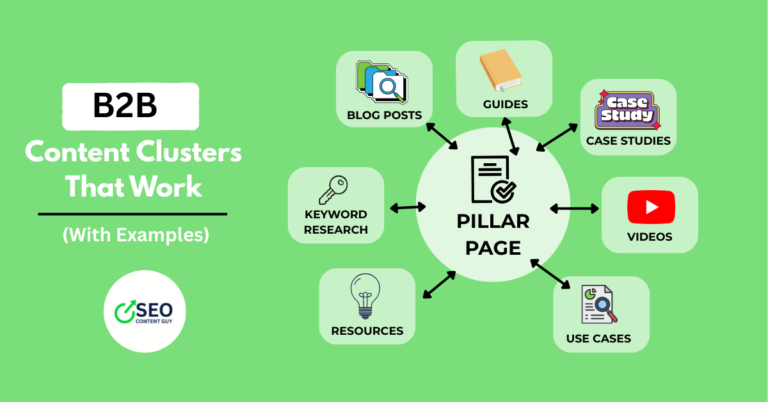
A topic cluster is the backbone of a strong SaaS content strategy.
The way it works is that you pick one broad topic that matters deeply to your buyer. Then you build a long, detailed guide that covers that topic from every angle.
Usually, that is your pillar page.
While this page is critical, you then build shorter and more specific pages around it. The idea is that each of those speaks to one part of the broad topic in more depth. You know what? Those are your cluster pages.
Every cluster page links back to the pillar, the same way the pillar page should link to every cluster page.
The good thing about this structure is that it tells Google that your site is an authority on that topic. It also keeps your buyer moving through your content instead of bouncing back to search results.
For example, if your pillar covers B2B SaaS SEO as a full system for driving pipeline rather than just traffic, your cluster pages would go deep on specific parts of that system. And that includes keyword research, technical SEO, product-led SEO, conversion problems, and so on.
Now, the reality is that building this topical cluster is not optional for SaaS companies competing in crowded markets. This is critical because random or standalone blog posts do not rank consistently as connected topic clusters do.
Step 3: Do Keyword Research Like a Revenue Team, Not a Content Team
Most SaaS companies do keyword research wrong. They look for high-volume keywords and write content for those keywords. And then they wonder why they get traffic that never converts.
The right way to do keyword research for B2B SaaS is to start with buyer intent, not search volume.
One paramount question you should ask is this: What does someone search right before they need a product like yours? Once you have the clear answer to this question, you can then work backward from that.
Now here’s the catch: High-intent keywords often have low search volume. This explains why queries such as “Best project management tool for SaaS startups” get fewer searches than “what is project management.”
The truth? The person searching for the first one is much closer to making a buying decision.
This is why, in your keyword research, you need to ask these three questions for each keyword:
- Who is searching for this? Is it your actual buyer, or is it a student, a journalist, or a competitor?
- What do they want from this content? Information, a tool, a comparison, or a purchase?
- Where are they in their decision process? Early research, active evaluation, or ready to buy?
Essentially, you don’t need to create content for a keyword that does not bring in your buyer at a useful stage.
In short, high customer acquisition costs in SaaS often trace back to content that attracts the wrong audience. It is not bad sales as marketing teams in the B2B may think.
Step 4: Plan Content That Converts, Not Just Ranks
Ranking is not the goal but only a “means” to the goal: the pipeline.
This is where most SaaS content strategies break down. A piece of content can rank on page one of Google and still fail to generate a single lead. This is often the case when your content does not clearly connect the reader’s problem to your product’s solution.
And the outcome is that they will read it and leave.
Now, note that every piece of content you publish needs these three things:
1. A clear job to do
Is this piece meant to generate sign-ups, book demos, or push the reader to another piece of content? It’s essential to decide this before you write.
2. A next step
Every article should tell the reader what to do next. This shouldn’t be with a desperate pop-up or a hard sell, but with a natural link to a related resource or a clear call to action that fits the moment.
3. Product relevance
At some point in the article, the reader should understand what your product does and why it matters to their problem. Again, a better way to do this is in a useful way, not in a salesy way. Guess what? If your B2B content is not converting with decent traffic, this is usually the missing piece.
Step 5: Handle Technical SEO Before You Scale Content
This is a mistake many SaaS companies make. They publish 50 pieces of content and then wonder why none of them rank. Often this is the case because the content is fine, whereas the website is not.
Technical SEO for SaaS is the foundation that holds everything else up. For instance, if Google cannot crawl your pages, your content does not matter. Likewise, if your site loads slowly, your rankings will drop.
This is also true for a poorly structured website. For instance, if your pages are structured poorly, Google will not understand what you are trying to rank for.
The bottom line? You should check the SEO basics before you scale content production to ensure that:
- Your pages load in under three seconds on mobile?
- There are no duplicate content issues from your SaaS app or trial pages
- Your internal linking structure is clean and intentional
- Your site architecture matches your topic cluster structure
The idea is to fix the foundation first. And then build on it.
Step 6: Decide Who Executes the Strategy
Fine, you now have the strategy. But that’s only one part of the equation — you need to decide who builds it. Whether that’s in-house, an agency, or a hybrid depends on your stage, budget, and internal capacity; see our full breakdown of SaaS SEO agency vs. in-house for how to make that call, and what SEO services for SaaS actually cost before you budget for it.
One thing that does not work is treating content as a side project. If nobody owns the strategy, nobody owns the results.
Step 7: Measure What Matters
Traffic is a vanity metric if it does not lead anywhere. Now you’d ask, what are the right metrics for a SaaS content strategy? Some of them include:
- Organic-sourced leads: The question to ask and answer here is: How many leads come from people who found you through search?
- Conversion rate by content type: Here, you want to discover which pages turn readers into sign-ups or demo requests.
- Assisted conversions: This involves practical actions that answer the question: How often does a piece of content appear on the path to a closed deal, even if it did not drive the last click?
- Keyword ranking movement: You can rank for keywords that lack commercial intent. But the emphasis here is answering this question: Are you moving up for the high-intent keywords that matter?
With that said, here’s the catch: If your organic traffic is falling or stalling, these metrics will tell you where the problem is. So while traffic dropping tells you something has changed, conversion data tells you what to fix.
The Honest Reality About SaaS Content Strategy
A SaaS content strategy does not produce results in 30 days. Organic search takes time. But companies that build the system correctly see compounding results. As a rule of thumb, each piece of content you publish should support the others.
This means that each cluster you build makes the next one rank faster.
The bottom line? Companies that fail at content are not the ones that started slow. Rather, they are the ones who publish without a strategy, skip common SEO mistakes that kill growth —not skill—and give up before their investment pays off.
If you’d rather have this system built for you than build it yourself, that’s exactly what our content strategy and creation service is for.
This is why building a system is important, as much as following the structure and measuring the right things are. You know what? That is how content becomes a pipeline. If you want this built for your SaaS company rather than doing it alone, see our SaaS SEO service to understand how we structure this for B2B SaaS teams.
This article is part of a complete guide to SEO for B2B SaaS.