

B2B SEO is the process of using organic search to reach the decision-makers, technical evaluators, and procurement teams who research a purchase long before they ever talk to sales. Done well, it turns search visibility into a qualified pipeline instead of just traffic.
This guide to B2B SEO strategy might end your search for a perfect one if you consume it like your favorite meal.
You’re reading this, most likely because you run a B2B website or sit on the decision-making team at a SaaS company and want to change this narrative:
“SEO feels overwhelming for my team.”
That’s all the qualification you need to get the best from what you’re about to learn…
Key TakeAways
Like every decision-making member of a B2B team (or as a B2B marketer), you’re possibly looking for ways to use SEO as a marketing strategy to make your product and brand more visible.
And the big question you ask is: HOW?
In this guide, you’ll discover how B2B SEO differs from B2C, how to map keywords to a longer, more complex sales funnel, and which content cluster models actually deliver results.
And even more, you’ll discover essential SEO metrics that truly connect to revenue, how to track return on investment, and how to align SEO with sales.
So, how do you stop creating content that only looks good on paper but cannot generate leads for your B2B company?
Before we get into that, let’s answer a question many B2B founders, CMOs, and others who are new to B2B SEO often ask.
B2B SEO Best Practices at a Glance
- Set one or two SEO outcomes tied to a dollar value, not a dozen vanity metrics
- Build buyer personas around pain points and search behavior, not just job titles
- Audit technical foundations (crawlability, speed, structured data) before producing content
- Target intent, not keyword volume — low-volume, high-intent terms convert better
- Build content clusters around pillar pages instead of publishing standalone posts
- Map keywords to funnel stage (awareness, consideration, decision) and buyer role
- Track SEO KPIs tied to revenue — organic MQLs and pipeline value, not just rankings
- Align content with sales through a shared library and content SLAs
- Earn backlinks from trusted industry sources, not link volume
- Run periodic audits — markets and buyer intent shift over time
See the full step-by-step breakdown of each practice below.
What is a B2B SEO strategy?
A B2B SEO strategy is the set of actions a business-to-business company takes — content, technical optimization, and keyword targeting — to attract decision-makers through organic search and convert them into qualified leads, not just traffic.
In simple terms, this is the marketing approach B2B companies use to drive prospective customers to their brand and products through search engine optimization, aka SEO.
In other words, a B2B SEO strategy is more than just targeting the right keywords. It is a full set of actions designed to attract the right people, often decision-makers at other companies, and guide them toward becoming customers of your B2B brand.
Part of those actions includes publishing industry-specific content such as case studies and practical guides, and supporting the longer sales cycles common in B2B. It also means building authority through content that connects, such as pillar pages and topic clusters, carefully grounded on strong technical SEO.
That said, the reward from successfully executing an effective B2B SEO strategy goes beyond traffic. You attract qualified leads and earn real trust from business buyers. This is why SEO in B2B is not a “nice-to-have” marketing tactic. It’s a core revenue channel when you get it right.
That brings us to a critical fact about B2B buyers:
Core Research Behaviours of B2B buyers
A survey by Inbox Insight of over 800 B2B buyers across the United States and EMEA shows that B2B buyers do their homework (as research) before making decisions.
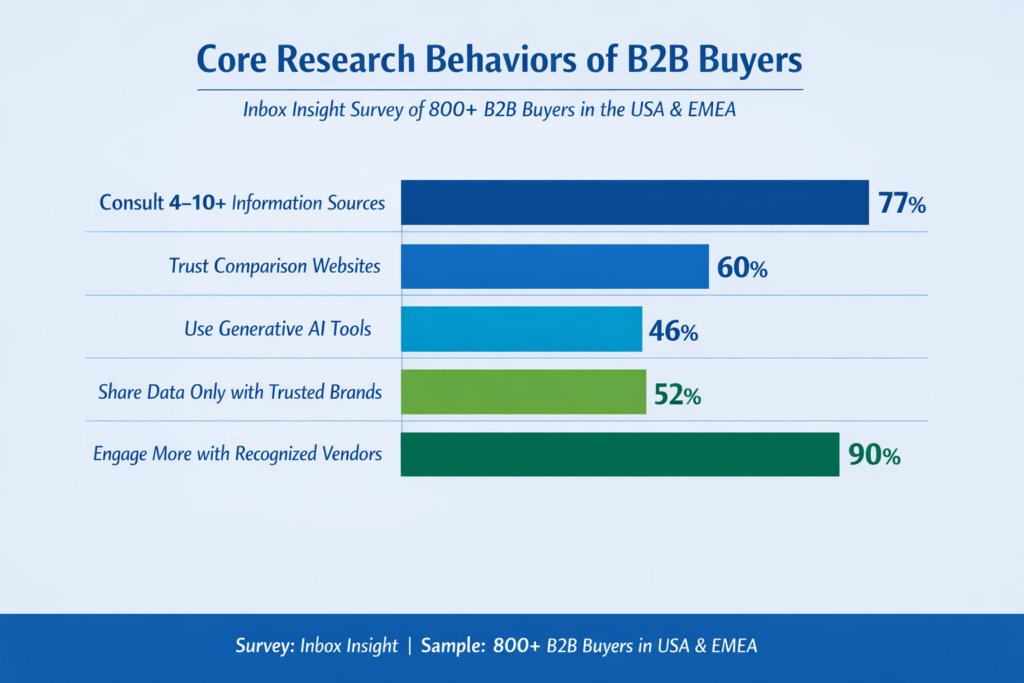
According to findings of this survey, 77 percent of these B2B buyers check four to ten (or more) sources before making a decision. Sixty percent rely on comparison sites they trust. And nearly half already use generative AI to guide their research.
More than half will only share their data with brands they trust, and nine in ten are far more likely to engage with vendors they already recognize.
With all that groundwork in place, you now understand what B2B SEO strategy means and how B2B buyers take their time to research before they buy.
It’s time to look at clear and practical actions you can take to build a strong B2B SEO strategy from the ground up.
B2B SEO Strategy Step-by-Step
Most businesses, including B2B companies, become so caught up in tactics that they lose sight of their business’s real goal. But that’s a typical reflection of a business’s priorities in the wrong order.
And that’s why it’s critical to start by focusing on outcomes that actually matter. Are you trying to drive more demo requests, generate marketing-qualified leads, or close large enterprise deals?
The idea is to be clear and specific.
For example, if your goal is to increase demo requests, you might prioritize creating content that answers specific questions your target audience searches for before requesting a demo.
That said, below are practical steps that B2B businesses can take to tie their SEO efforts directly to measurable business outcomes, rather than just chasing traffic.
Step #1. Set clear goals and boundaries.
You’ll hear plenty of so-called marketing gurus tell you to track dozens of metrics. In reality, most B2B businesses only need to focus on one or two outcomes that SEO can actually influence.
That might be demo requests from organic search, qualified trial sign-ups (prospective customers who sign up for a free trial), or leads from your target industries. The idea is to assign a dollar value to each lead, so you can later measure ROI and clearly see what’s actually working.
Step #2. Know Your Buyers Like Close Friends
You can’t overstate the importance of truly knowing your customers, and that applies just as much to B2B businesses. This is why clear buyer personas matter.
People debate how many you need, with some saying three to five is enough to cover the key roles. But the exact number matters less than the depth of understanding.
Of course, the real deal is knowing your buyers’ pain points, priorities, content habits, and search behaviour. That said, since most B2B purchases involve several stakeholders, it’s vital for B2B brands to map each persona to the questions their prospects ask at every stage of the funnel.
Step #3: Audit Your Technical and Content Foundation
Once you’ve set clear business goals and truly understand your ideal customers, the next step is to audit your site’s foundation. That means checking both your website’s technical elements and content.
Of course, that would entail running a full site crawl to check indexability, page speed, canonical tags, and structured data. This is critical because even great content can’t perform well if technical issues are holding it back behind the scenes.
As John Mueller noted in an article on SE Ranking, technical SEO is key for rankings and user experience. So when it’s ignored, it can weaken every other optimization effort you make.
Step #4: Target intent, not vanity keywords
This step emphasizes the need for B2B companies to build their business web pages around what users are actually looking for. Are they trying to learn about a product? Are they trying to compare alternatives? Or are they just ready to buy?
The key is understanding user intent and targeting it carefully.
Most pages on the web fail because they don’t match what users want. According to a 2024 report, Ahrefs reports that 96.55% of all pages get no search traffic from Google.
This means that the goal is not more pages. A few high-quality pages that genuinely help your audience are far more effective than a hundred low-quality pages that rarely provide any value.
Step #5: Design a Content Cluster, Not Spray
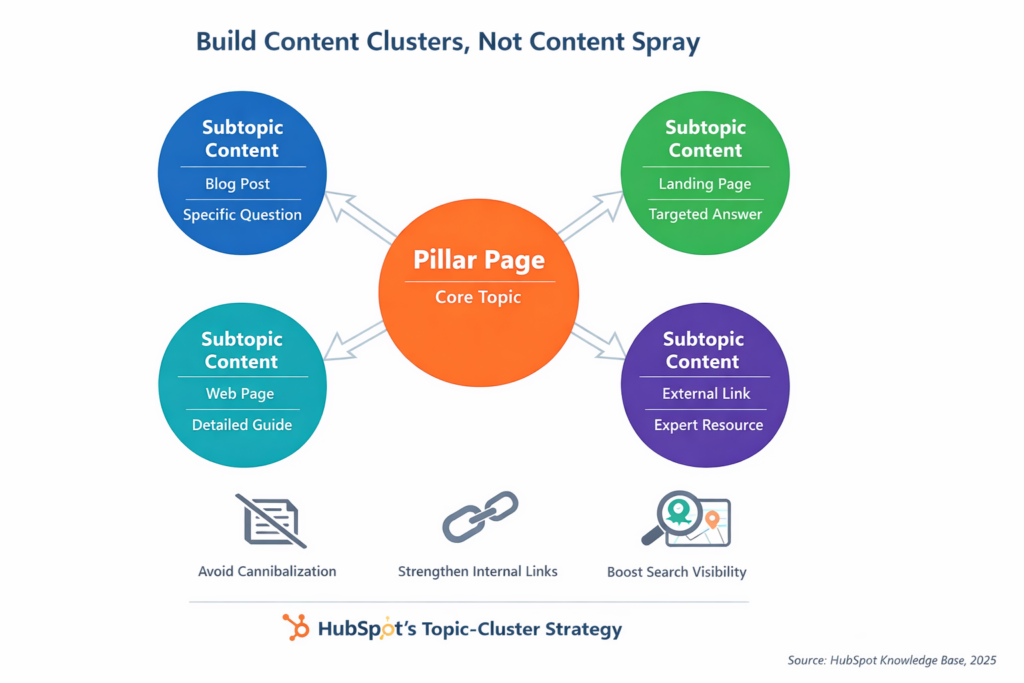
This strategy is fast gaining popularity. And it focuses on building thoughtful content clusters rather than posting content randomly.
As a practical step in a B2B SEO strategy, B2B companies can start by creating pillar pages for their main topics and then add supporting pages that address specific sub-questions.
Essentially, it is a method that reduces content overlap, strengthens internal linking, and gives search engines a clear view of your brand’s expertise. HubSpot’s topic-cluster framework provides a practical way to organize content that later improves both discoverability and user experience.
The good thing is that you can explore effective B2B content clusters to see how this strategy works across different industries and use them as a blueprint for your own approach.
Step #6: Build a Content Operations Model
A content operations model is a clear plan for creating, reviewing, publishing, and measuring your content. Simply put, it involves deciding who writes a piece of content, who edits it, who publishes it, and who tracks its performance. And yes, it entails using editorial briefs to guide every piece.
This is why, for a B2B business, each brief should outline the buyer persona, search intent, target keywords, conversion goal, call-to-action, and distribution plan. The goal is to treat SEO content like a product. You launch it, test it, and improve it based on the results.
Step #7: Measure, learn, and repeat.
No B2B SEO strategy is complete without measurement. This is why it’s critical to track your key performance indicators weekly or biweekly, and to allow you plan your strategy each quarter.
The truth is that SEO works best when you give it steady, focused effort over time and adjust based on what you learn.
Now note that a B2B SEO strategy isn’t limited to just these seven steps. They are just the essentials. Of course, there’s more to it in practice.
That said, the fundamentals of search engine optimization remain the same for any business; yet B2B SEO works differently from B2C. And understanding these differences is key. That brings us to our next subheading:
Step #8: Know Differences between B2B and B2C SEO
B2B buyers take longer to make a purchase and often involve several people in the decision. They use more specific keywords, and even low-search-volume keywords can bring valuable leads.
Both gated and ungated content help move buyers through the sales journey. Buyers also look for proof before they choose a product. Some of these proofs include case studies, customer references, and compliance certifications.
Read our guide on the key differences between B2B and B2C SEO for a full explanation and real examples.
Step #9: Map Keywords to Your Sales Funnel
Matching your content to different people involved in a buying process is one thing. And it’s another to understand prospective customers’ buying journey.
Interestingly, that’s where mapping keywords to funnel stages and buyer roles becomes crucial. But the question is, how do B2B do this?
Here’s a practical way to connect keywords to your B2B sales funnel:
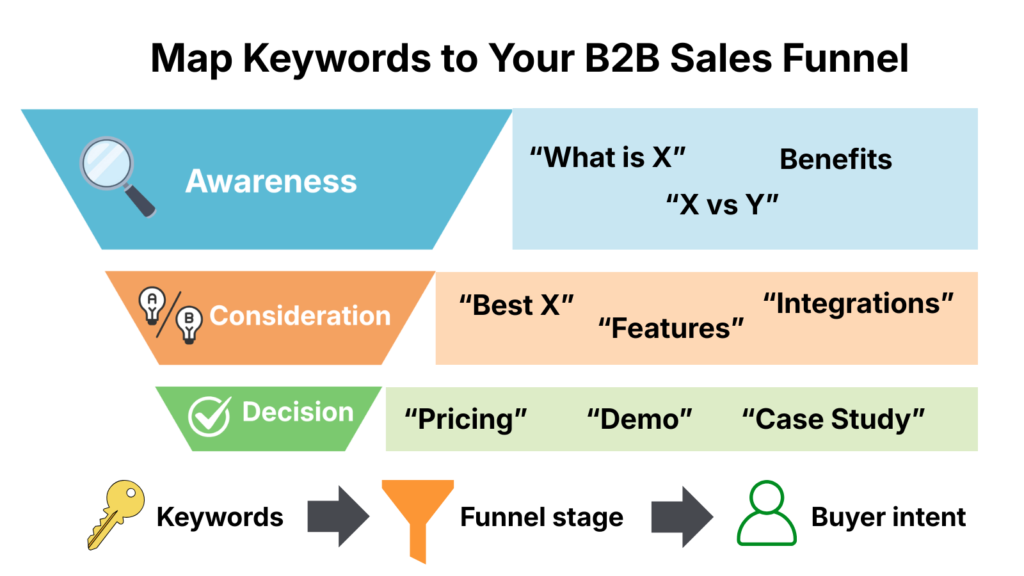
A good starting point is defining your funnel stages. And they often include these three:
- Awareness: This is the stage in which potential customers are busy exploring and learning about problems or solutions.
- Consideration: At this stage, they’re evaluating options and comparing solutions.
- Decision: Last but not least. Here, your potential ideal customers are ready to pick a vendor. Thus, they are checking pricing or requesting demos.
With that in mind, it’s pertinent to match keywords to intent. Some typical examples include:
- Awareness keywords: “what is X,” “benefits of X,” “X vs Y,” “how to improve X process.”
- Consideration keywords: “best X for [industry],” “X features comparison,” “X integration with Y.”
- Decision keywords: “pricing for X,” “X demo,” “X customer case study.”
Okay, let’s look at some niche examples for B2B brands.
Starting with a SaaS company that provides “HR automation,” for the awareness stage, prospective buyers or customers might be using search queries like “what is HR automation.”
And when they move to the consideration stage, ideally, they’ll type queries like “HR automation software comparison.” It gets even more interesting as they begin to search queries like “HR automation software pricing demo.” At this point, you know these buyers are right at the bottom of the funnel, almost ready to make the purchase.
That’s also true for EdTech companies that provide a Learning Management System (LMS) for universities. Ideally, here are typical search queries that a B2B buyer for this product would use at the different stages in their customer journey:
- Awareness: “learning platform benefits for higher education.”
- Consideration: “best LMS for universities 2025.”
- Decision: “LMS implementation case study university.”
The bottom line?
Every page should have a clear next step.
For instance, awareness pages can offer a checklist or video, while consideration pages can nurture with an email sequence. And then, the decision pages should allow potential customers to request a demo.
So, how do you do the selection of appropriate keywords?
Undoubtedly, you can use search tools. They can be helpful and allow you to check volume, related questions, and other things. This is where a robust B2B keyword research process becomes invaluable, as it goes beyond just finding terms to understanding the specific language and intent of business decision-makers.
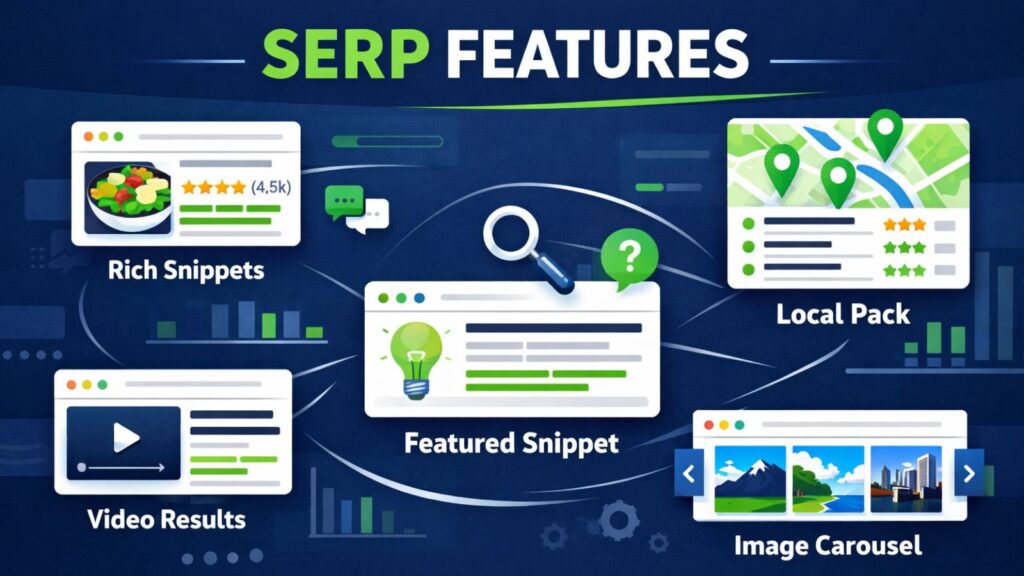
In any case, efforts shouldn’t be limited to these keyword research tools. And that’s because the SERP features can be a great place to get inspiration, clues, and hints.
Now, note that keywords by themselves won’t take your business very far. In short, you have to decide which content is worth creating based on real business value. Of course, you can keep it simple and focus on these three things:
- How many clicks do you expect?
- how often visitors convert, and
- What each deal is worth.
Let’s look at this example. Suppose a keyword brings in 1,000 clicks a month, but only 0.2 percent of those visitors convert. If the average deal is worth $2,000, the probability is that such content can generate about $4,000.
Now, another keyword might attract just 200 clicks, but if 5 percent convert and each deal is worth $10,000. Hypothetically, that content could drive $100,000.
That’s why prioritization matters. Fewer clicks can still deliver far more revenue. And if these calculations feel overwhelming, you can always use a simpler ROI formula later.
Step #10: Use Content Cluster Framework
Not all content clusters perform the same. In B2B, the models that consistently deliver better results are those that match how buyers research and make decisions. Some of these frameworks include:
Pillar with a Technical Hub
This one is often ideal for SaaS. For instance, a SaaS company can start with a broad pillar such as “Customer Data Platform Guide.” After that, they can support the page with technical pages like “CDP API integration,” “CDP for B2B marketing,” and “CDP case studies.”
The fascinating thing about this cluster model is that its setup attracts early interest while giving technical evaluators the depth they need.
Use-Case Clusters
Often, this model is ideal for professional services. Essentially, the focus is on real buyer situations. For instance, a pillar on “Enterprise Data Governance” can lead to pages such as “Data governance for banks,” “Data governance case study for mergers,” and “Checklist for implementing data governance.”
With this, all these clusters help buyers see exactly how your solution applies to their world.
Value-Driven Case Study Clusters
This falls under the “case study” cluster, and as you know, trust often comes from trust. That said, it’s ideal for EdTech and service companies. For instance, a pillar such as “Learning Outcomes with LMS” can connect to pages like “Case study: University X improved retention,” “How to measure learning ROI,” and “Implementation timeline and checklist.” Usually, strong case studies push buyers closer to a decision.
Regulatory and Compliance Hubs
Many buyers begin their search with compliance questions. And this makes it suitable for regulated industries. For instance, a pillar like “Regulatory requirements for fintech” can branch into topics such as “PCI DSS basics” and “How to prepare for a SOC 2 audit.”
Usually, a B2B company that answers these questions early builds confidence and credibility.
Those are just some of the top B2B Content Cluster Models that can drive good SEO results. However, it’s vital to note that each cluster should guide buyers from basic questions to deeper insight, and then toward the right call to action.
Meanwhile, you can check HubSpot’s topic cluster model. It can be a helpful framework in organizing this approach.
Step #11: Focus SEO KPIs That Drive Revenue
For years, many businesses, including B2B companies, have obsessed over search rankings. But the problem is that rankings can be noisy and misleading. Of course, sitting at the top of Google looks good on paper, but rankings on their own do not bring in B2B revenue.
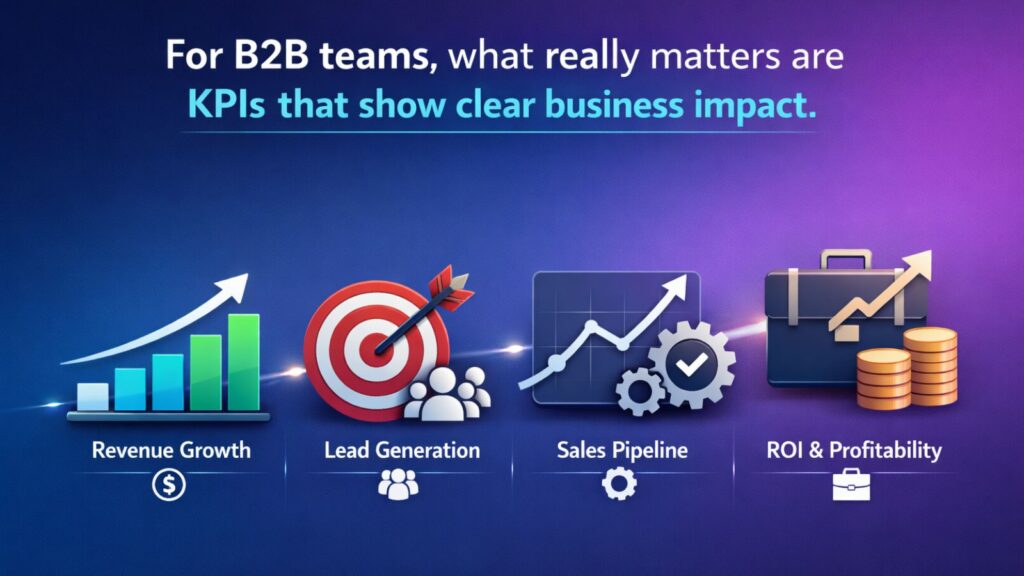
This is why, for B2B teams, what really matters are KPIs that show clear business impact.
Of course, you can start by measuring organic marketing qualified leads or demo requests generated from organic pages. Mostly, this should be your primary KPI. And that’s because your focus should be on which pages drive conversions, not just where they rank.
Another critical metric to track is organic conversion rate by landing page. This is critical because traffic alone means nothing if visitors don’t take action. The idea is to measure how each page converts and break it down by funnel stage.
The next SEO KPI a B2B company would want to track is the value of qualified organic leads. You can do that by multiplying your lead volume by average deal size and close rate to estimate how much pipeline SEO is actually creating. (You’ll get this in clear terms in a moment.)
For example, let’s assume that your B2B business’s organic search brings in 100 qualified leads in a quarter. If your sales team closes 10 percent of those leads and the average deal is worth $10,000, that means SEO is influencing $100,000 in potential revenue.
That figure looks massive on paper, right?
Yet numbers like that are what make SEO performance clear to both marketing and leadership.
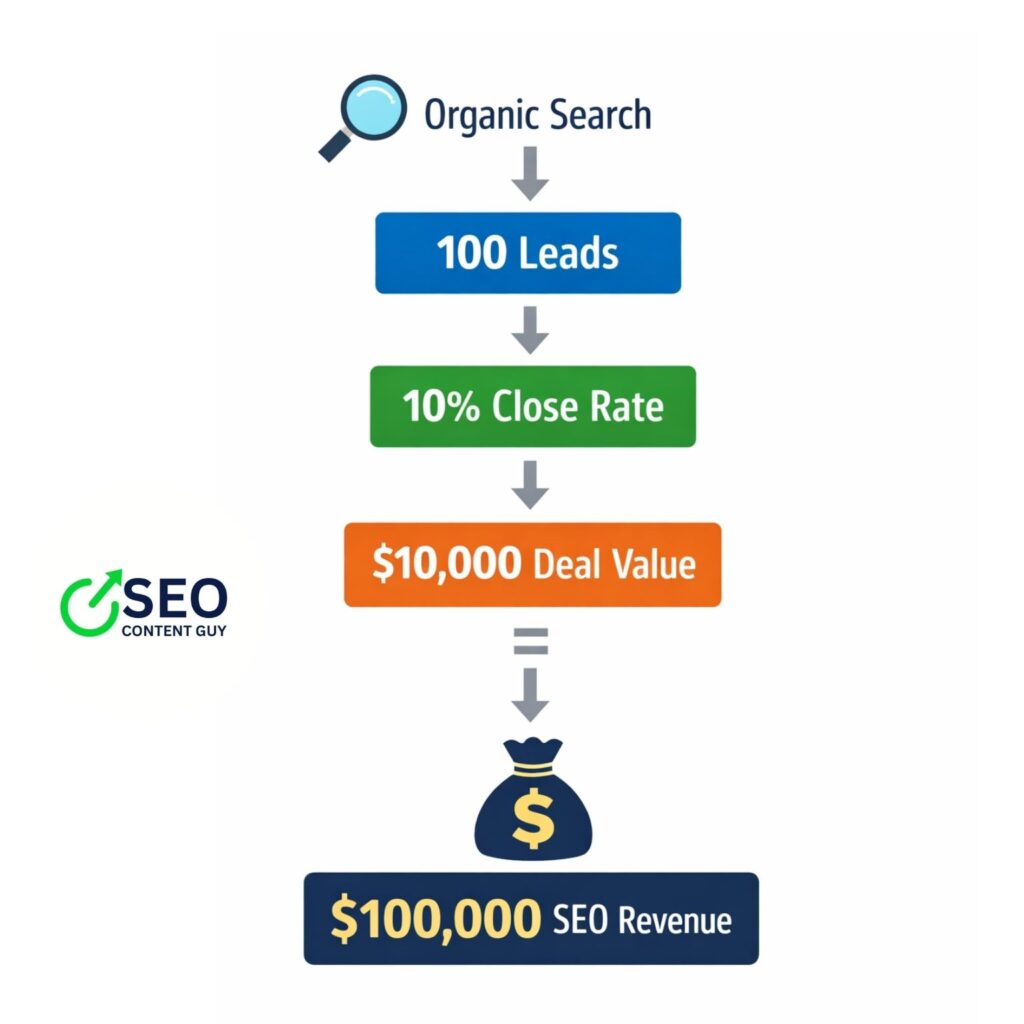
Estimated SEO Revenue = Number of qualified organic leads × Close rate × Average deal size
To this end, it also helps to track how organic content supports deals all the way to the finish line. Of course, doing this would mean using multi-touch attribution to track how often your content plays a role in helping your brand to close a deal. And usually, that includes pieces of content such as blog posts, guides, or case studies.
For example, a buyer might first find your site through a blog post. And then he returns later to read a comparison page, and finally downloads a case study before booking a demo.
In this instance, even if SEO was not the final touch, it clearly helped move the deal forward. Thus, multi-touch attribution ensures that influence is visible, rather than giving all the credit to the last click.
It is worth remembering that you can measure many SEO metrics, but not all of them matter for growth. What really counts in B2B is knowing which SEO KPIs actually drive results.
That tells there’s a clear difference between numbers you can track and KPIs that influence real decisions. That is why you should focus on the metrics tied directly to revenue, not vanity numbers that look good but change nothing.
Step #12: Align SEO With Sales Enablement Practically
This is where many B2B teams fail. They create content that marketing loves and sales ignores. So it is an issue of misalignment in a B2B SEO strategy, one that can be fixed by making content useful for sales.
So the big question is, how do you align SEO and sales?
Here are practical ways you can resolve that:
Create a shared content library.
This is a library that both marketing and sales can use. Of course, the idea is to update it and make it easy to access. This way, sales teams can quickly grab one-pagers, battlecards, and customer stories.
Even more, your B2B can support this with short and SEO-friendly pages that include a clear call to action. Usually, with this, you make it simple for sales to share the right content with prospects at the right time.
Use content SLAs.
At its core, content service level agreements (SLAs) exist to keep marketing and sales aligned on what content is needed at every stage of the buyer’s journey.

In B2B, deals involve multiple people and long buying cycles. This is why everyone needs clarity on what content is required at each stage of a customer journey. Interestingly, that’s what a Content service level agreement helps resolve. It defines who creates each asset, who uses it, when it is delivered, and for which buyer it is meant.
Often, that structure removes guesswork and keeps teams accountable. For example, marketing can supply a one-page overview for senior decision-makers, a detailed technical guide for evaluators, and a short one-minute video for busy executives. This way, no one is left out or underserved.
According to HubSpot’s 2025 research, sales teams using enablement content in this way are 58% far more likely to beat their targets.
Empower Sales with Purpose-Driven SEO Content
Doing this would mean training sales teams to use SEO content with purpose by showing them which pages address specific objections and how to share them during outreach.
B2B brands can help their sales teams to smartly harness SEO content by tagging each piece in the CMS with the buyer role, funnel stage, and sales use case. This way, reps can quickly find exactly what they need when reaching out to prospects.
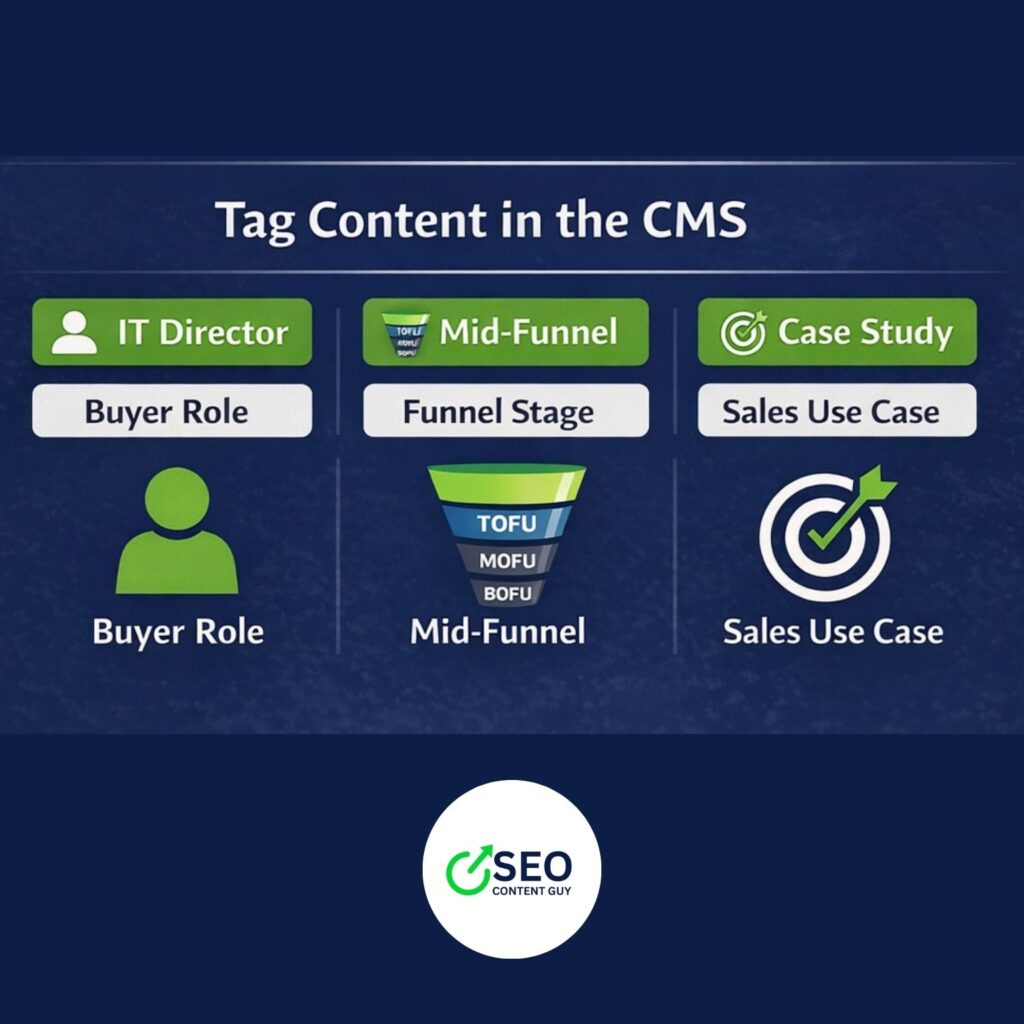
Finally, for your B2B brand, you can track which content actually helps close deals and feed those insights back into your content strategy. This way, you ensure your next pieces are guided by real sales impact, not guesswork.
According to 6sense’s 2023 B2B Buyer Experience Report, B2B buyers start researching solutions when they are already about 70% of the way through their buying journey. Often, at that point, most have already formed preferences for certain vendors.
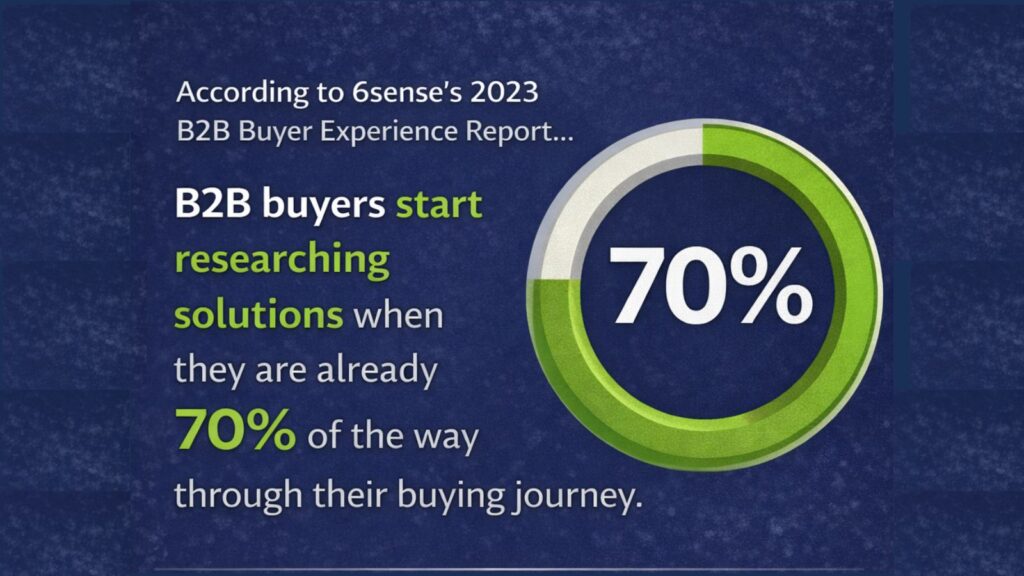
If sales and marketing teams are not fully aligned to deliver the right content at this stage, companies risk losing the deal before the first conversation even happens.
Step #13: Track ROI for your B2B SEO Campaigns
Measuring ROI for B2B SEO campaigns needs discipline, not guesswork. It’s critical for every B2B company. HawkSEM explains that ROI is calculated by directly comparing your SEO spend with the value of the conversions it drives.
This method often reveals to B2B marketers the impact that SEO has on revenue. It also helps them to make smarter budget decisions and proves that SEO drives real business growth. That said, for your B2B business, here are some key ROI metrics to track from your B2B SEO campaign:
1: Calculate the value per organic conversion
This measures the expected revenue impact of each lead you generate through SEO. Thus, as a B2B company using SEO as one of its marketing channels, the truth is that not every website visitor becomes a client.
That’s why this metric is so critical. Essentially, it accounts for the likelihood of closing a deal and its typical size. This way, B2B teams can focus on the traffic sources that deliver the most value.
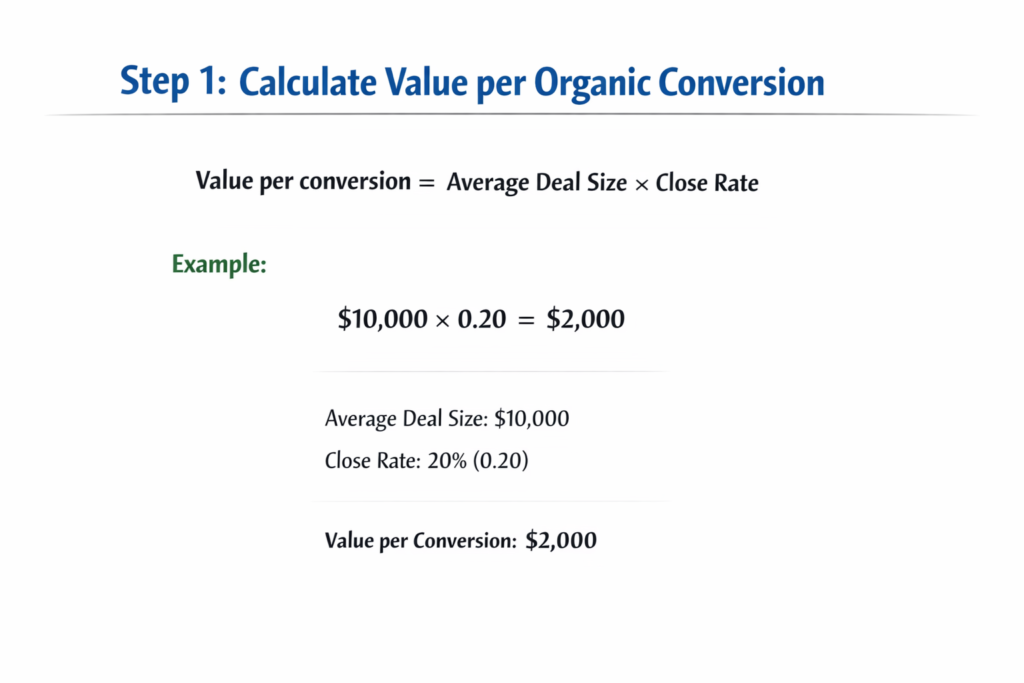
In simple terms, “value per organic conversion” shows the economic potential of a single organic lead. For example, if you have an average deal of $10,000 and 20 percent of SEO leads close, that means each conversion is worth $2,000.
Formula:
Value per conversion= Average deal size × Close rate
2: Measure SEO profit
This captures the net financial gain from SEO efforts, after accounting for all investments, such as content production, tools, or agency fees.
Take B2B, for instance, where sales cycles are longer, and campaigns often involve multiple touchpoints. This metric tells you whether SEO is truly adding value beyond just generating traffic. Simply put, it reveals the profitability of organic leads.
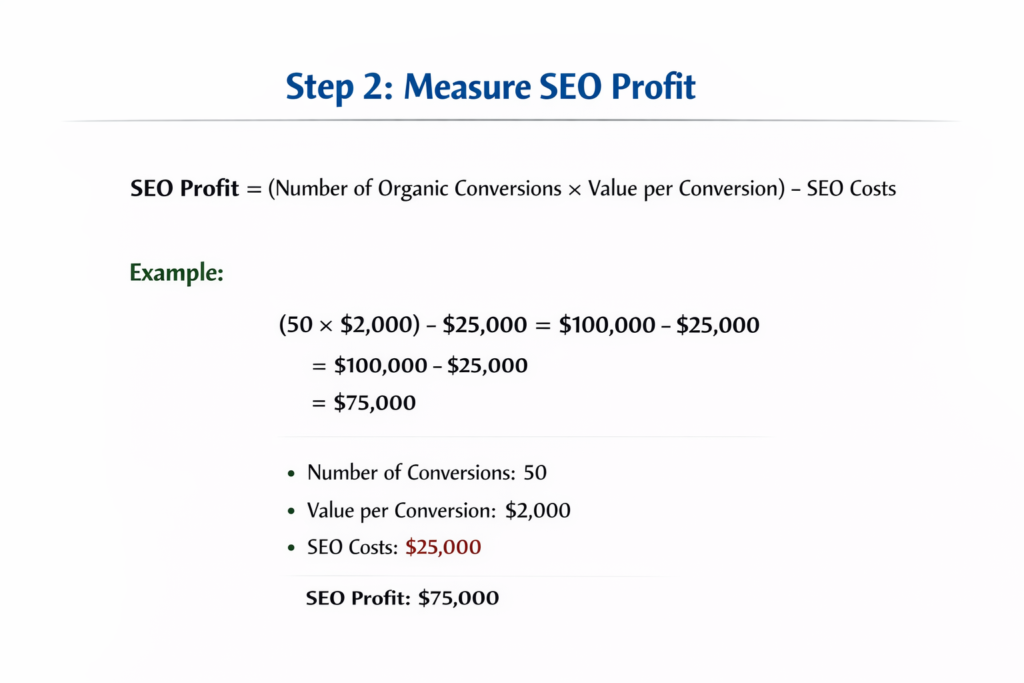
For example, if SEO drives 50 conversions for your business, and each is worth $2,000. If you do the math, that should sum up to $100,000 in revenue. Now, if your SEO costs for content and tools were $25,000, your SEO profit is $75,000 ($100,000 − $25,000).
Note, here’s the simple formula applied:
SEO profit = (Number of organic conversions × Value per conversion) − SEO costs.
3: Calculate SEO ROI
As a simple rule, ROI reflects the amount of profit your SEO investment has generated. Mostly in B2B, leadership and investors want to see that the money spent on search engine optimization delivers real value.
Thus, for decision-makers, SEO ROI should show how much return each dollar in organic search brings and whether your strategy is truly driving profitable growth. Yet, calculating SEO ROI in practice can be challenging.
In any case, using the example above, we can compute the “SEO ROI” by dividing the SEO profit by the SEO costs. Mathematically, that would be this: $75,000 ÷ $25,000 = 3, or 300% ROI.
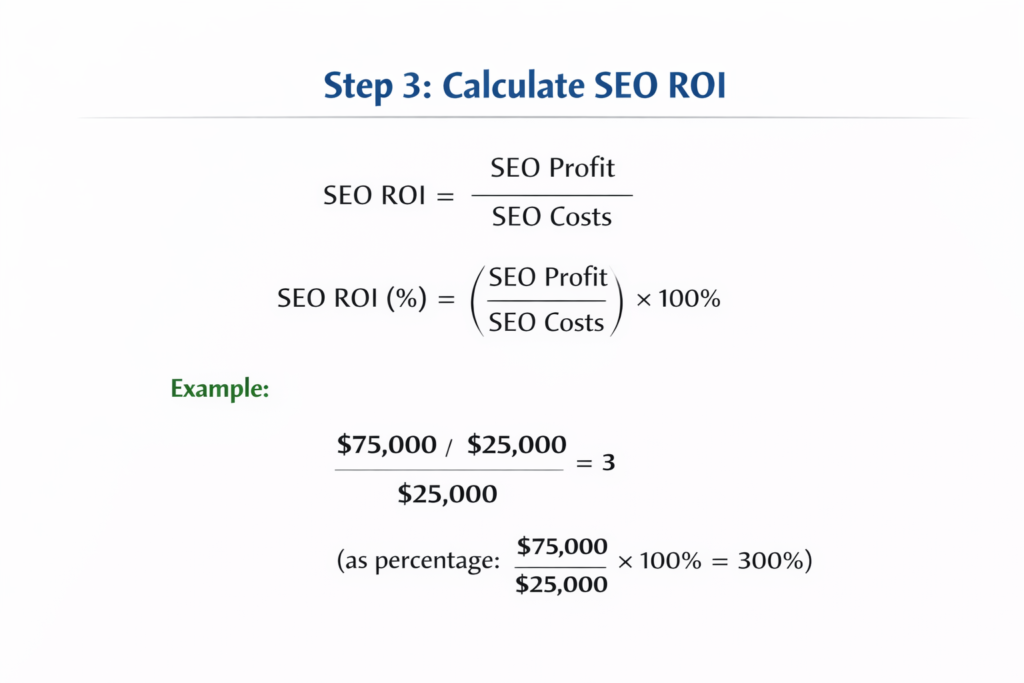
Formula for SEO ROI (ratio or percentage)= SEO profit divided by SEO costs multiplied by 100.
Now, the fascinating thing about this method is that it gives you a clear picture of what your SEO efforts are actually bringing in. Ultimately, it makes it easier to justify investment.
Again, the reality is that accurately calculating SEO ROI for most businesses can be challenging. According to Ahrefs, calculating it seems straightforward in theory, but accurate measurement is more complex.
That’s why it’s vital to consider how conversions are attributed and when results appear. But the stern reality is that SEO rarely delivers instant results. Mostly, early signs show up within three to six months, while meaningful revenue gains can take six to eighteen months.
With that in mind, it’s critical to note that timing depends on domain authority, competition, and the scale of your content efforts.
Step #14: Combine Helpful Content With Conversion Strategy
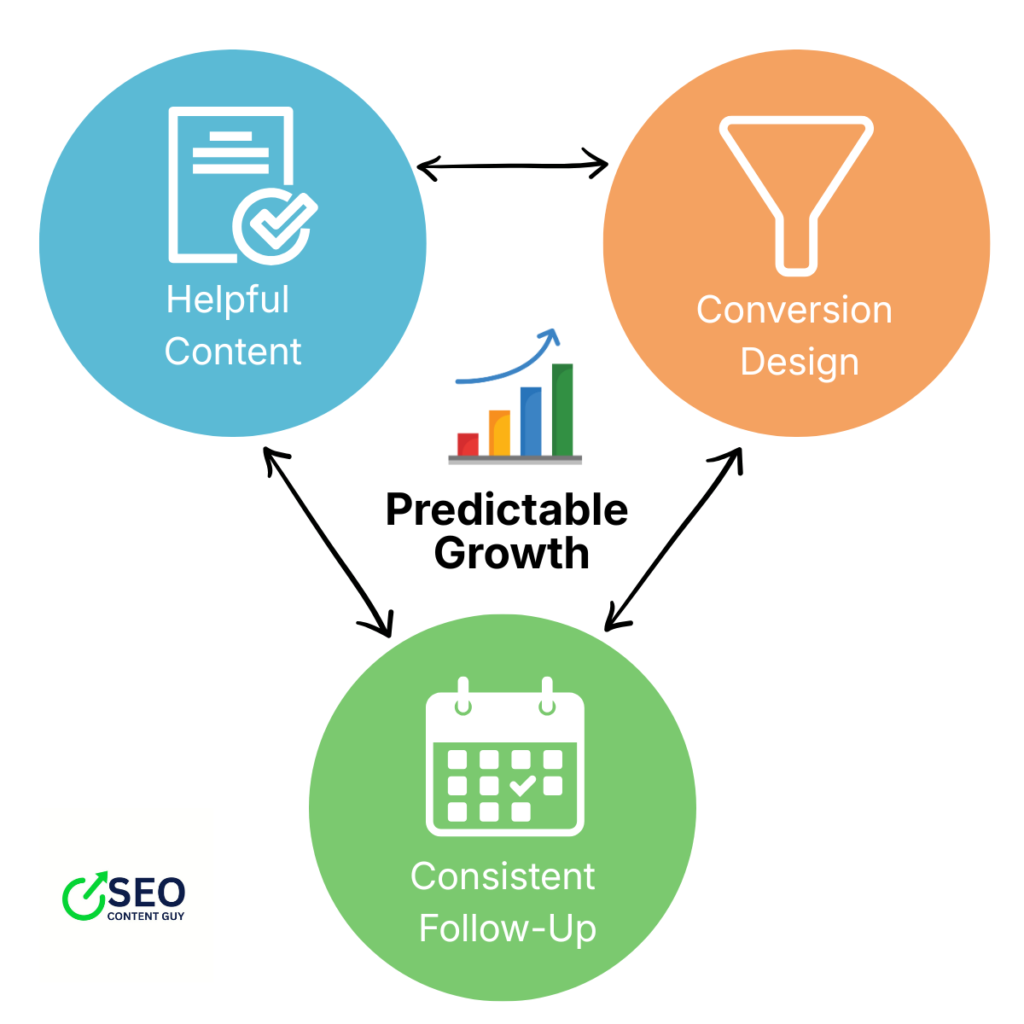
Organic lead generation receives a lot of attention, but it only works when these three things come together: helpful content, smart conversion design, and consistent follow-up. When these elements connect, SEO stops feeling uncertain and starts driving predictable growth.
You can start at the top of the funnel by earning attention. And this involves publishing ungated content that answers real buyer questions. Often, clear explainers, honest comparisons, and original research draw in people who are already searching for solutions.
The next thing is to move to the middle of the funnel by qualifying interest. This is where deeper assets play an essential role. Include guides, templates, and focused webinars. That said, at this point, you should apply caution when collecting information from your audience.
Of course, that would mean asking for an email first, then requesting details such as role or company later. Note that each step should feel like a fair exchange, not pressure.
What about at the bottom of the funnel? At this stage, it’s crucial to remove every barrier to action. In doing this, some of the strategies many SaaS companies use include offering product trials, live demos, ROI calculators, and detailed case studies.
In all of these strategies, the use of direct calls to action, short forms, pre-filled fields, and simple scheduling makes the next step easy.
Interestingly, in B2B, a few tactics consistently deliver results. For instance, search-optimized case studies show real outcomes in specific industries. Also, interactive tools, such as ROI and cost calculators, attract high-intent buyers. And yes, SEO-driven webinars perform best when they focus on one clear buyer problem.
More than anything, timing matters. While organic content can bring in buyers, your B2B brand needs to guide them forward based on the stage they are in their customer journey.
Step #15: Avoid These Common B2B SEO Mistakes
There is a long list of SEO mistakes that most businesses make quarter after quarter. But in this section, we’ll look at the common ones that many business-to-business brands commit every so often. This is to help you identify these issues early in your business and avoid wasting time, effort, and budget on SEO that doesn’t deliver real results.
The first common SEO mistake most B2Bs commit is treating SEO like a checklist. But in reality, milking the best from search engine optimization as a marketing channel doesn’t happen with a one-time set of fixes. In short, it’s an ongoing program that needs regular attention.
The second one involves focusing on rankings, not conversions. As I said, for a long time, businesses have worshipped “search ranking.” Yet the truth is that rankings aren’t an end in themselves. This is why rank trackers can keep teams busy, but they don’t make a business profitable.
The real question is, is your traffic turning into leads and revenue?
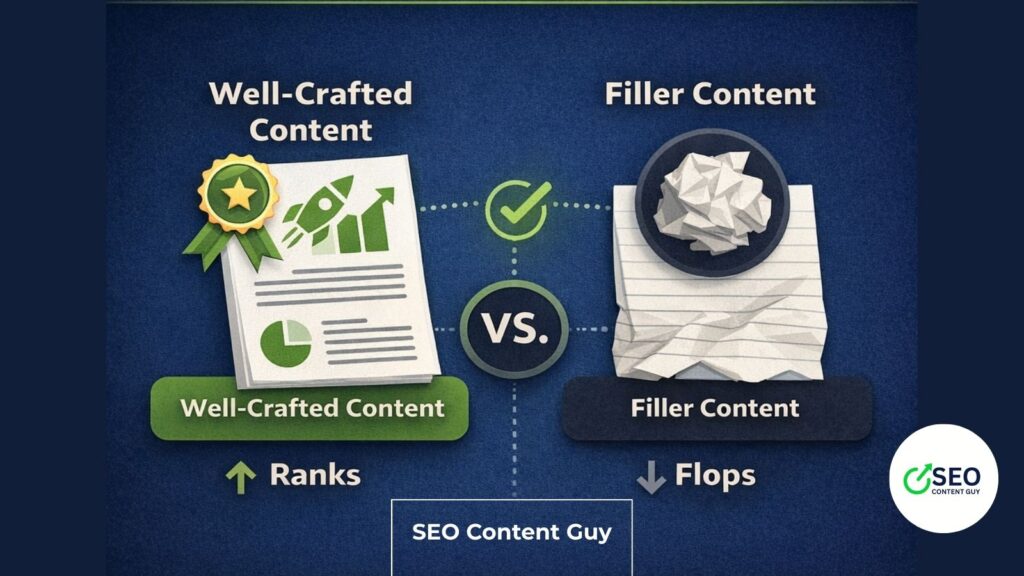
Another common mistake is publishing large volumes of low-value content. Many B2B fall into the trap of believing that the content game is one where quantity (or numbers) rule. As a result, they constantly create and publish large chunks of low-quality content.
Unfortunately, that approach rarely works. And that’s because quality beats quantity every time. In an article published on Moz, Rand Fishkin emphasized that high-quality and valuable content matters far more than pumping out mediocre pages. This is the same truth that Google teams have consistently echoed.
That’s why search engines reward relevance and usefulness, not filler. Thus, a well-crafted piece of content consistently outperforms content created to fill space.
Another common SEO mistake in B2B is poor alignment with sales. And this can directly hurt results. The truth is that when sales teams do not use the content marketing created, all that effort goes to waste.
Finally, amongst others, many teams skip measurement altogether. And this oversight can be massively anti-growth. The point is that without a clear plan to track performance, there’s nothing to optimize.
You know what?
If you avoid these mistakes, you’ll give your SEO strategy and campaigns a chance for success. And most importantly, you’ll save yourself months of wasted effort and frustration. For an even deeper dive into the specific pitfalls that can derail your efforts, be sure to read our related piece on B2B seo mistakes and learn how to steer clear of them from the start.
Step #16: Earn Quality Backlinks
In B2B SEO, links matter most when they come from trusted industry sites your buyers already follow.
Earning those links starts with listing core topics connected to your products, use cases, and buyer challenges. After this, you then match those topics to publishers, partners, associations, and SaaS blogs that regularly cover them.
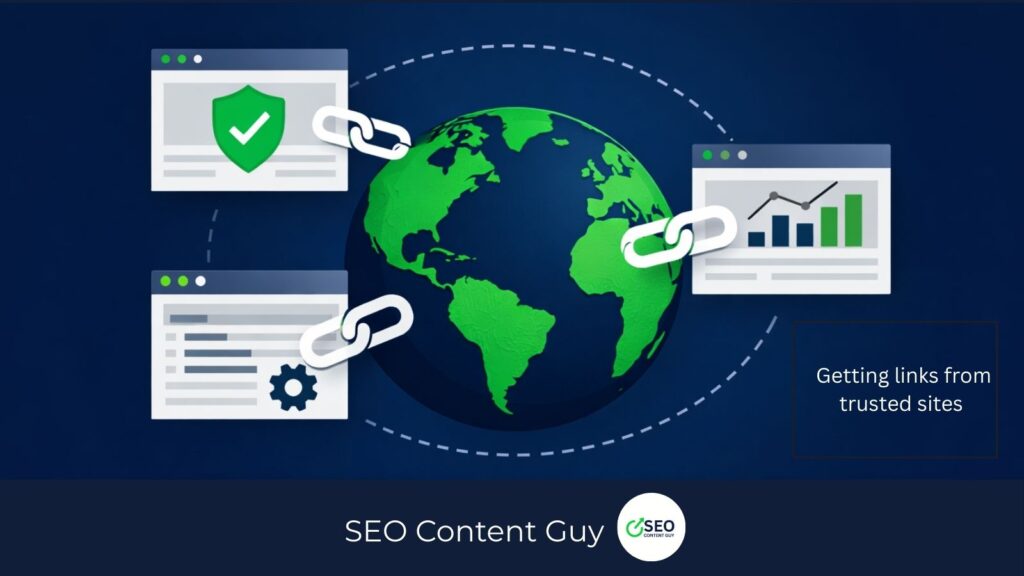
Once that’s done, the next thing is to create content people want to link to, such as original research, benchmark reports, in-depth guides, and data-backed opinions. The idea is to give others a real reason to reference your work.
Link-worthy pieces of content like those are often an asset for your brand. And mostly, they build topical authority and strengthen your overall SEO, not just a few keywords.
This is why when you or your B2B team reach out to publishers, it’s critical to lead with intent. Of course, that would mean sharing a clear idea that brings value to their audience. This is more effective than just sending a generic pitch.
Last but not least. As you try to earn quality backlinks, it’s important to focus on relationships, not one-off links. And this can manifest as co-authoring articles, providing expert quotes, and supporting partners with shared content.
Now, note that tracking your backlinks is as important as getting them. You can track that by their source quality, topic relevance, and role in conversions. In B2B, a small number of strong and relevant links will outperform dozens of weak ones every time.
Bonus Step: Do Periodic SEO Audits
You keep your B2B strategy grounded in reality by running regular SEO audits. The truth is that markets shift, competitors improve, and buyer intent changes over time. And that’s where an audit comes in. It helps you catch gaps early before they slow pipeline growth.
You can start with the technical basics. That would mean checking crawlability, indexing, site speed, and internal linking. But beyond this, it’s important to review your content with intent in mind.
Most importantly, ensure every page still serves your buyer’s needs and supports your core topics, not just keywords. As you examine your site rankings, do that alongside conversions, not in isolation.

Essentially, beyond volume, you should review backlinks for relevance and trust. It’s critical to tie every insight back to business goals. Recall, a strong audit turns SEO from guesswork into a clear plan that drives revenue, not just traffic.
Final Thoughts
SEO takes time to show its full impact. In your B2B company, you may see early wins such as your web pages getting indexed or a new snippet appearing in a few weeks.
But real revenue changes usually take six to eighteen months. With this in mind, it’s critical to pay attention to what moves the needle for your business. Part of that entails focusing on steady growth in Marketing Qualified Leads, publishing high-value case studies, improving technical SEO, and ensuring your sales team and content are aligned.
Now, a good place to start is to create one strong content pillar that addresses your key buyer pains, track the results carefully, and then expand on what works best.
Read more>> Why B2B Websites Struggle to Attract Qualified Leads
This playbook gives you the strategy. But if you want it executed without building the capability in-house, our SEO services for B2B companies cover the full scope, from keyword research to content and technical SEO.