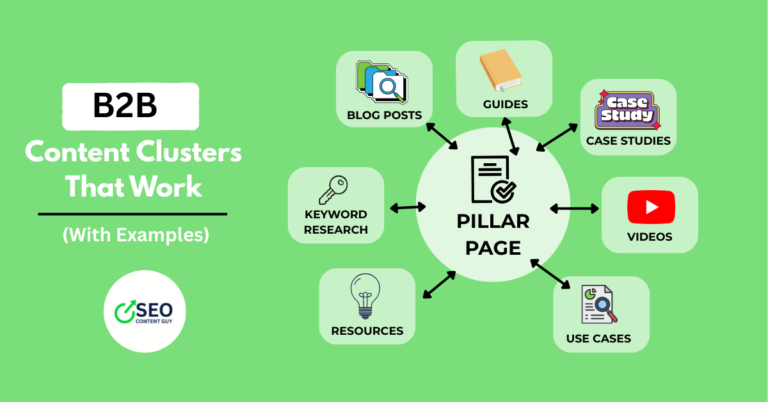

It is one thing to want to build a content cluster strategy, and another to find a tool that can actually help you build it without drawing in spreadsheets.
So you can have a pillar topic and a list of cluster posts to create, and still be asking one question this article answers: which platforms support how B2B content clusters work at the operational level?
To start with, note this isn’t about which ones have the longest feature list. But the ones that remove the friction that kills most cluster strategies before they gain traction.
In this article, we compare five platforms: MarketMuse, Surfer SEO, Clearscope, Frase, and HubSpot. You will see what each one does inside a real cluster workflow, who it is built for, and where it fails.
That said, if you want to understand how pillar and cluster content actually works before picking a tool, start by first reading our B2B content clusters guide, and then come back here.
Quick answer: The five platforms discussed in this article support a B2B pillar-and-cluster content model: MarketMuse (best for spotting cluster gaps), Surfer SEO (best for optimizing individual posts to rank), Clearscope (best for teams whose writers aren’t SEO specialists), Frase (best for building briefs quickly), and HubSpot (best for tying cluster performance to CRM revenue data). Most B2B teams combine two: one for planning, one for writing and optimization.
That’s only a short version. Note that picking the wrong platform for your current stage is the expensive mistake you don’t want your team to make. The breakdown below shows exactly which constraint each platform solves, and where each one fails.
What a Content Cluster Platform Actually Needs to Do
Most teams read the feature page and buy the tool. That is the wrong order. While a feature page tells you what the tool can do, you need to know which job in your cluster workflow it handles.
The point is that every cluster build has five jobs. The good thing is that each platform on this list does one or two of them well and is weak on the rest. Here are the five jobs:
- Spot the gaps. See which cluster posts you are missing before you write the wrong content.
- Optimize each post. Ensure each cluster post covers its topic well enough to rank before it goes live.
- Build writer briefs. Turn a keyword into a brief that a writer can execute without a week of research.
- Visualize the cluster. See the full structure of your cluster as a connected system and spot what is broken or missing.
- Track results. Measure how the cluster performs as a unit, not just how one post ranks.
Now here’s the thing: No single platform handles all five jobs. This is why most B2B teams that run serious cluster strategies combine two tools: one for planning and the other for writing and optimization. Continue reading because you’ll discover the best combinations at the end.
MarketMuse: Best for Spotting What Your Cluster Is Missing
MarketMuse does one thing better than any other tool on this list. It shows you exactly which cluster posts are missing from your site before you waste time writing the wrong content.
What it does
Once you enter your pillar topic, MarketMuse scans your entire site, scores your current topic authority, and compares your content against the sites already ranking for that topic. At the end, you get a list of cluster posts your site is missing, sorted by the impact of adding them.
MarketMuse heatmap shows you the gaps visually. Green means a competitor covers that subtopic well. Red means nobody covers it well. And the red cells are your editorial calendar.
Another thing to take note of is its Topic Navigator. It shows you a visual map of how subtopics connect inside your cluster. With this, you see which cluster posts should support which others and where the internal links need to flow. This visualization makes building a cluster feel like architecture instead of guesswork.
That said, if you need a method for deciding which keywords go on which cluster page, “How to Cluster Keywords for B2B SEO covers that process. While MarketMuse gives you the topic map, the keyword clustering guide provides the grouping logic to fill it.
Where it stands out for B2B corporate blogs
B2B topics are complex. Take, for instance, a cluster around “revenue operations” or “enterprise data governance” has dozens of real subtopics. With this in mind, most keyword tools show you keyword variations of your seed term. But MarketMuse shows you the subtopics that carry actual conceptual weight in your category.
It also adjusts difficulty scores based on your own domain. For instance, a B2B blog that already publishes heavily on content strategy gets a different priority list than one starting from scratch. This personalization is what makes the gap analysis something you can act on, not just look at.
Where it fails
MarketMuse does not help you write or optimize individual posts. Once you know what to write, you still need another tool to ensure each post is strong enough to rank.
Pricing now requires a sales conversation for higher tiers. Paid plans start around $99 per month. The truth is that for solo founders, publishing a few posts a month is a hard price to justify. It earns its cost for teams managing clusters of 20 or more posts.
MarketMuse | cluster gap identification
Best for: Content teams building multi-post clusters who need to know what to write next and in what order.
Skip it if: Teams that need a writing editor, per-post scoring, or a low-cost entry point.
Price: A free plan is available. But paid plans range from around $99/month.

Surfer SEO: Best for Making Each Cluster Post Strong Enough to Rank
Surfer SEO operates at the writing stage. So where MarketMuse tells you what to write, Surfer tells you whether what you have written is good enough to compete. As a tool, Surfer runs inside your writer’s workflow every time they produce a cluster post.
What it does
The moment you open a Content Editor and enter your target keyword, Surfer pulls up the top-ranking pages for that query. Then, it shows you the NLP terms those pages use, how long they are, how many headings they have, and which semantic topics they cover.
Another interesting thing is that your document gets a live content score from 0 to 100. The score updates every time you add or change content.
A score of 70 means your post covers the topic adequately, while a score above 85 means you are competing at the level of the current top-ranking pages. Writers do not need to have a solid understanding of SEO to use it. They see a number, and they work to improve it.
Surfer also has a Content Planner and a Topical Map. You enter a broad cluster topic, and Surfer groups related keywords into clusters, while showing you which queries belong on the same post and which need their own page. This helps you plan the cluster before writing starts.
Where it stands out for B2B corporate blogs
Surfer integrates directly with Google Docs and WordPress, so writers can optimize content without leaving the tools they already use. That seamless workflow sets it apart from many alternatives. Instead of switching between multiple apps, writers can stay focused and get their work done in one place.
That said, for B2B blogs where multiple people touch each post before it goes live, Surfer creates a shared quality standard. And yes, the content score becomes the shared benchmark for “ready to publish.” That removes the subjective back-and-forth that slows down editorial cycles.
Where it fails
Surfer looks at one post at a time. It does not show you the site-wide picture of your cluster or tell you which posts are missing. For that view, you still need MarketMuse or a manual GSC audit.
Another downside is that its cluster visualization is limited to the topical map inside the Content Planner. This means it will not show you the full architecture of your published cluster or where the internal linking is broken.
Surfer SEO | per-post optimization
Best for: B2B content teams that publish cluster content regularly and use it to maintain a consistent quality standard before every post goes live.
Skip it if: Teams that need site-wide cluster gap analysis or strategic planning.
Price: Discovery plan from $49/month (annual). Essential plan: $99/month.

Clearscope: Best When Your Writers Are Not SEO Specialists
Most B2B content teams write cluster posts using subject-matter experts, not SEO specialists. Clearscope is built for that situation. It gives non-SEO writers a clear quality target they can hit without needing to learn how search optimization works.
What it does
With Clearscope, you enter a keyword, and it produces a report showing the terms top-ranking pages use and how often they use them. Writers see a letter grade from F to A++. This grade improves as they add the terms Clearscope highlights. This quality check helps writers know they are done the moment they hit their target grade.
Clearscope also has a Content Inventory that tracks the grade of every published post in your account. For a B2B blog running a cluster strategy, this tells you which cluster posts are slipping below their target grade and need a refresh. You do not have to audit them manually.
Where it stands out for B2B corporate blogs
Clearscope gives you unlimited user seats on every plan. This means you can add every writer, editor, and subject-matter expert to the tool without the cost going up. Undoubtedly, that matters for B2B blogs that pull in product managers, engineers, or legal reviewers as contributors.
For B2B topics that need deep expertise, like financial services regulation or enterprise security, the writers who know the topic well enough to be credible are usually not the ones who know SEO. Clearscope bridges that gap without asking them to learn a new discipline.
Where it fails
Clearscope does not do cluster-level planning. It scores individual posts against the SERP but does not tell you which cluster posts are missing, how your topic authority compares to competitors, or where the internal linking gaps are.
Surfer starts at $129 per month. If your blog publishes fewer than 10 posts each month, you’ll likely pay a high cost per content report.

Clearscope | writer-friendly semantic optimization
Best for: B2B blogs where subject-matter experts or general writers produce cluster content and need a simple grade to aim for.
Skip it if: Teams that need cluster gap analysis or a lower cost per post.
Price: Essentials plan from $129/month. Unlimited user seats on all plans.
Frase: Best for Building Cluster Post Briefs Quickly
If the bottleneck in your cluster build is briefing writers, Frase solves that. And that’s because it turns a target keyword into a structured, SERP-backed brief in just a few minutes. That is the job Frase was built for, and it does it faster than anything else on this list.
What it does
Once you enter a keyword, Frase pulls the top-ranking pages, extracts their headings, the questions they answer, the NLP terms they cover, and the word count distribution. And then, it builds a brief that your writer can start from immediately. The point is that a brief that used to take 45 minutes of manual SERP research now takes five minutes in Frase.
Frase also includes a content editor with a real-time optimization score. While this is not as precise as Surfer or Clearscope for high-competition keywords, it is good enough for most cluster posts targeting mid-level queries.
Now here’s the thing about Frase: it is especially useful when you are briefing several cluster posts at the same time.
That said, if you are working through a cluster and need to brief writers on five supporting posts in parallel, how top B2B brands structure their clusters shows you what those supporting post architectures look like in practice. Frase takes you from keyword to content brief without slowing you down with manual research.
Where it stands out for B2B corporate blogs
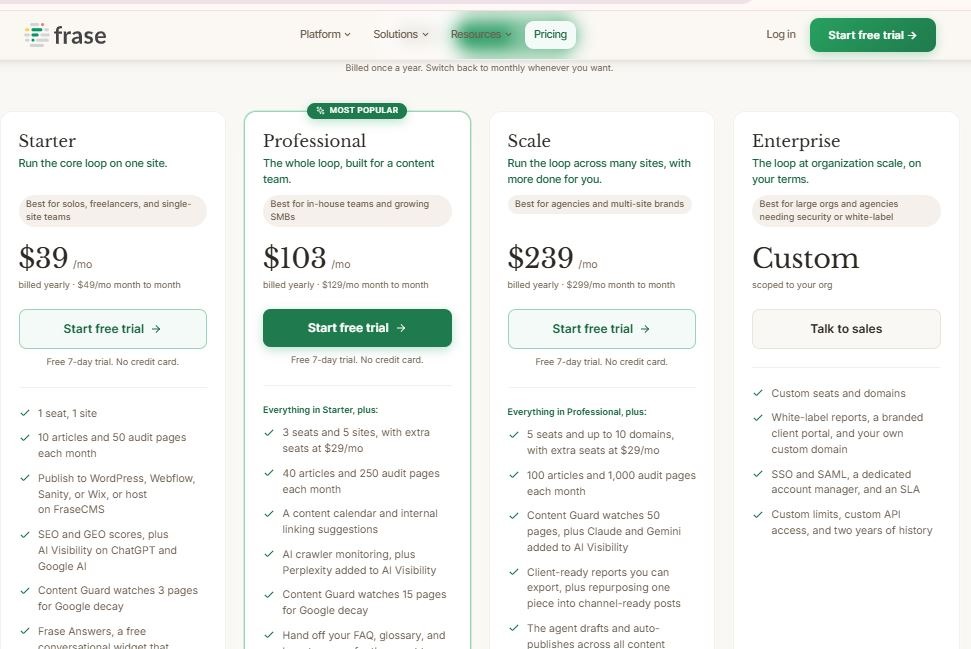
Frase starts at $39 per month on annual billing. But if you’re building your first B2B content clusters, it gives a cost-effective way to create data-backed content briefs instead of relying on instinct.
For blogs that use freelance writers or agencies, Frase briefs reduce revision cycles. Writers start with a structured document showing competitor headings, common questions, and priority terms. And the interesting part is that first drafts come back closer to ready.
Where it fails
Frase does not do site-wide analysis. It cannot tell you which cluster posts are missing from your site or how your topic authority compares to competitors at a domain level. It works post by post.
Its optimization scoring is also less precise than Surfer or Clearscope for pillar pages or cluster posts targeting the most competitive head terms in your category.
Frase | brief generation for cluster posts
Best for: B2B teams briefing multiple writers in parallel who need SERP-grounded briefs fast.
Skip it if: Teams that need site-wide gap analysis or precise optimization for high-competition keywords.
Price: From $39/month (annual). Monthly billing from $45/month.
HubSpot: Best for Connecting Your Cluster to Revenue Data
HubSpot is not a content optimization tool. Neither does it score your writing nor identify topic gaps. It connects your content cluster performance directly to your CRM. As a result, B2B founders, CMOs, and marketing teams can prove that their content generates pipeline—not just traffic. That’s a level of insight no other tool on this list provides.**.
What it does
Inside HubSpot’s SEO tool, you build your cluster structure directly. You designate a pillar page, attach cluster posts to it, and link them together. HubSpot tracks how your pages connect and reports on your content cluster as a unified system – not as a collection of individual posts.
The CRM layer is what makes HubSpot different. Every contact in your CRM is tied to the content they engaged with. And yes, you can see which cluster posts drove contact form submissions, content downloads, or demo requests. The good thing is that you are not tracking which posts get traffic, but which posts generate leads.
Where it stands out for B2B corporate blogs
B2B CMOs get asked to justify the content budget. And the stern reality is that traffic numbers do not close that conversation. But showing that your content cluster drove 18 marketing-qualified leads last quarter, with an average deal size tied to that traffic, does. And note that HubSpot is the only tool on this list that gives you that argument.
If you want to see how other companies have structured their clusters before deciding how to track performance, read this article on how top B2B brands organize theirs. It shows you the architecture patterns that tend to drive the most measurable results. The brands with the highest pipeline impact from cluster content typically have the tightest CRM connection.
Where it fails
HubSpot does not optimize content. It does not tell you whether your cluster posts are semantically strong, which topics you are missing, or how your content quality compares with your competitors’. Hence, you still need MarketMuse or Surfer for that work.
Marketing Hub Professional, which gives you the full topic cluster toolset, starts at $890 per month. Here’s the thing: If you are not already a HubSpot customer, buying it only for cluster tracking is hard to justify.
HubSpot | cluster performance tied to pipeline
Best for: B2B companies already on HubSpot CMS who need to connect cluster content to CRM data and prove ROI to stakeholders.
Skip it if: Teams that need content optimization, gap analysis, or a budget-friendly entry.
Price: Marketing Hub Starter from $20/month. Professional (full cluster tools) from $890/month.

Side-by-Side: Five Platforms, Five Jobs
Use this table to find the gap in your current stack.
| Platform | Spot gaps | Optimize posts | Build briefs | Visualize cluster | Track results |
|---|---|---|---|---|---|
| MarketMuse | Strong | Weak | Strong | Strong | Basic |
| Surfer SEO | Moderate | Strong | Moderate | Moderate | Weak |
| Clearscope | Weak | Strong | Moderate | Moderate | Moderate |
| Frase | Weak | Moderate | Strong | Weak | Weak |
| HubSpot | Weak | Weak | Weak | Strong | Strong |
Most B2B teams that run a full cluster strategy use two tools. MarketMuse for spotting what is missing. Surfer or Clearscope for making each post strong. And while Frase sits in the middle as the briefing layer if you manage external writers, HubSpot sits on top of all three if pipeline data matters to your stakeholders.
Which Platform Should You Pick?
Match the tool to the job that is slowing you down right now. Do not buy more tools than the problem requires.
You do not know which cluster posts to write next.
Use MarketMuse. Enter your pillar topic, run the cluster analysis, and let the heatmap tell you where the gaps are. At the end, you will leave with a prioritized list of posts to write. And yes, you can build from there.
Your cluster posts are not ranking, and you do not know why
Use Surfer SEO or Clearscope. If your writers have some level of familiarity with SEO and you want the most granular feedback on topic coverage and competitive scoring, use Surfer. But if your writers are subject-matter experts who do not know SEO, you can use Clearscope. This is because the letter grade is something anyone can act on without training.
Briefing writers is the bottleneck, not the writing itself
Use Frase. If briefing five cluster posts takes your team a full week of research, Frase compresses that to an afternoon. At $39 per month, it is also the lowest-risk entry point on this list.
Your CMO needs proof that content drives revenue, not just traffic
Use HubSpot. It is the only platform on this list that ties cluster post performance to contacts, leads, and deals in your CRM. It makes the most sense if you already use HubSpot because the cluster tools are included in your existing subscription.
You are running the full cluster workflow from scratch
Combine MarketMuse for planning with Surfer or Clearscope for per-post optimization. Add Frase if you brief external writers. And yes, you can add HubSpot if you need pipeline reporting. That stack covers every job in the cluster workflow without overlap.
What About Geo Goals and Region-Level Cluster Tracking?
Some B2B companies build cluster content for multiple markets, such as the UK and the US, DACH, and France, or even several cities within the same country. They need a platform that lets them set location-specific goals and track cluster performance in each region.
The honest answer: none of the five tools above does native geo-level cluster tracking better than what you can build yourself in Google Search Console. And this is because GSC shows impressions, clicks, and average position filtered by country for any URL. Layer that against your cluster post list in a spreadsheet, and you have regional cluster performance data.
And as for city-level tracking or more granular geo SERP data, you can combine any of the tools above with Semrush or Ahrefs. This is because both support location-level keyword tracking.
To do that, set up keyword groups that match your cluster structure, tag them by region, and track performance changes at the “cluster-level” in your rank tracker. That is a two-tool setup, but it is more practical than waiting for a single platform to build it natively.
Start With the Right Stage, Not the Most Popular Tool
Most B2B blogs stall on content clusters because they buy the wrong tool for the wrong stage. Not only that, they invest in a per-post optimizer before they know what posts to write. Another possible reason is that they map the entire cluster architecture but never build a quality control system for the writing.
This is why picking the tool that removes the constraint you are actually facing is critical. The idea is to build that stage first. And then, add the next tool when that constraint is gone. And if you are still working out your B2B content cluster strategy at the architecture level, sort that out before you invest in any of the tools above. These tools only perform as well as the content cluster structure you build beneath them.
And no matter which platform you pick, none of them will stop two of your cluster posts from quietly targeting the same keyword unless you’ve already mapped each keyword to a single page. That’s a separate discipline from tool selection — see our guide to keyword mapping for SaaS for how to assign every keyword to one clear page before you start building.