
How do you actually compete for tough keywords in SaaS SEO?
That’s a question you’ve probably thought of as a B2B SaaS founder and Chief Marketing Officer at some point. In short, chances are that you’ve built a solid content strategy, targeted the right keywords, and published consistently without seeing meaningful results.
The point is that you’ve checked the rankings and see that your content is nowhere on the first page, which is dominated by big brands such as Salesforce, HubSpot, G2, and Capterra.
For most SaaS teams, the natural response to this reality would be to keep publishing and hope the rankings improve. But that’s not how it works. A smarter response would be to rethink the strategy entirely.
The reality is that competing in a crowded SaaS market is not about producing more content than your competitors. It is about producing smarter content that targets the specific places where large competitors are weak, distracted, or simply not paying attention.
The point is that there are always gaps. And that’s the job of a SaaS keyword strategy in a competitive market. It helps you to find those gaps and build authority inside them before anyone else does.
This article gives you a complete playbook for doing exactly that.
Why Standard Keyword Strategies Fail in Competitive SaaS Markets
Most SaaS keyword strategies follow the same logic. A SaaS team finds keywords with decent search volume, checks the difficulty score, and targets anything below a threshold. Ultimately, they publish and wait.
But here’s the thing with that approach: it works reasonably well in markets with low competition. But it breaks down completely when you are operating in a category where established players have been investing in SEO for five or ten years.
And here is why: Keyword difficulty scores are averages. They reflect the aggregate strength of the pages currently ranking. For instance, when Salesforce or HubSpot ranks for a keyword, their domain authority is so high that the difficulty score for that keyword rises even if the content they published is mediocre.
Given all that, the point is that you are not competing against weak content. You are competing against a domain with thousands of backlinks and a decade of topical authority.
And trying to outrank those domains on their strongest keywords with standard blog posts is not a content strategy. It is a way to spend your budget on content that will never rank.
The bottom line is that a competitive SaaS keyword strategy starts with a different question. Instead of asking “what keywords have the most search volume,” you should ask “where are the big players weak, and what can we win right now?”
That reframe is the foundation of the keyword research approach that separates revenue-generating content from content that just takes up server space.
The Four Competitive Keyword Tactics That Work for SaaS
Tactic 1: Long-Tail Keyword Clustering
Large competitors almost always dominate the short, high-volume head terms in any category. They do not dominate the long-tail. And the good news is that in B2B SaaS, the long-tail is where your buyers live.
For instance, a head keyword like “project management software” has enormous competition. The top results are ICAgile, Wrike, The Digital Project Manager, and ProjectManager.
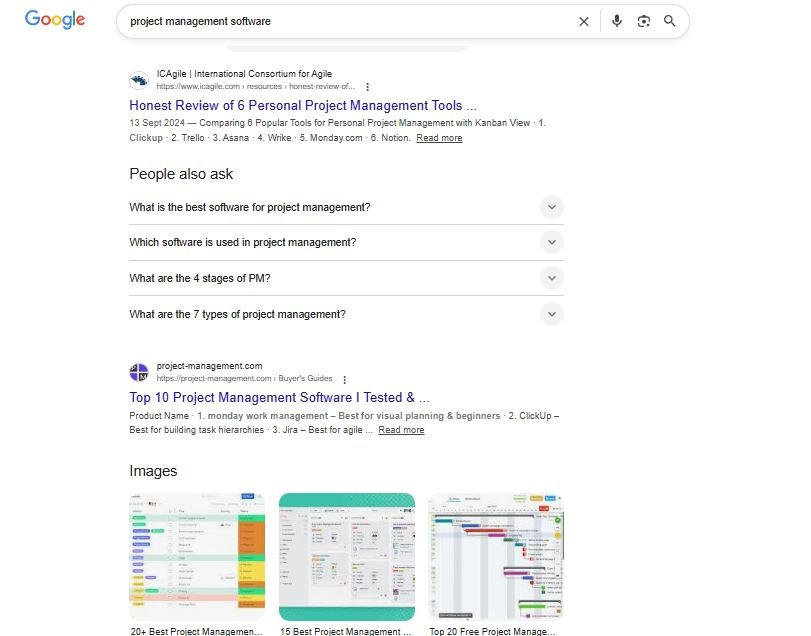
It’ll be impossible to beat or outrank them for that keyword. But for a term such as “project management software for distributed engineering teams under 50 people,” it’s a completely different story. That specificity filters out casual browsers and surfaces only the buyers who match your ICP exactly.
And that’s why long-tail keyword clustering is important. It means grouping related long-tail keywords under a single piece of content that answers a very specific question for a very specific buyer. So instead of writing one broad article, you write a detailed, precise page that speaks directly to the person searching that exact term.
Although keywords or phrases like these have a lower search volume and minimal competition is minimal. But their conversion rate is dramatically higher. The point is that over time, a collection of long-tail cluster articles builds topical authority that begins to pull you into rankings for more competitive head terms you could never have targeted directly at the start.
The goal is not to win every keyword, but to win the keywords your exact buyers search, and to do it in a market where your competitors have not bothered to show up.
This long-tail approach is also where zero-volume keywords in niche B2B markets become one of your sharpest competitive advantages. The reality is that if your keyword tools show no volume for a term, your competitors are almost certainly ignoring it. And that is the opportunity.
Tactic 2: Topic Niching
Large SaaS companies have large audiences. Hence, they write broad content that tries to appeal to everyone. While that breadth is their strength in terms of reach, it is their weakness in terms of depth.
And that’s where topic niching comes in. It means going deeper on a subject than any competitor has bothered to go. In practice, this means you find a specific angle within a broader topic and build a cluster of content that covers it more thoroughly than anyone else on the internet. And before you know it, you become the authoritative source on that narrow subject.
For instance, a large competitor might have one blog post about “customer success for SaaS.” But you can go ahead and build a full cluster. One that would constitute a pillar page, cluster articles on specific customer success metrics, onboarding frameworks, churn prediction models, and health score methodologies.
The idea is to ensure each article links to the others, even as the whole cluster reinforces the topical authority of every page within it.
The truth is that Google rewards depth. This is why a site that covers a narrow topic comprehensively outranks a site that covers it superficially, even if the superficial site has a higher domain authority. With this in mind, you can say that “topic niching” is the primary mechanism that allows small-domain SaaS companies to beat large players on specific subjects.
This is why understanding how B2B keyword research maps to specific buyer personas and job titles is critical. Because it’s what makes topic niching precise rather than arbitrary. Of course, you do not niche into any topic. The goal is to niche into the exact topic your specific buyer searches and evaluates at the personal level.
Tactic 3: Adjacent Keyword Targeting
Adjacent keywords are terms that sit one step away from your core product category. They attract buyers who are problem-aware but not yet solution-aware. Simply put, this category of buyers or prospects has not started searching for your category yet. But the problem they are searching for is one your product solves.
For instance, a sales engagement platform might target keywords around “cold email response rates” or “SDR productivity metrics.” Those are not product keywords. They are problem keywords. But the thing is that the people searching them are exactly the buyers who need a sales engagement platform.
Adjacent keyword targeting expands your addressable search audience beyond the buyers who already know your product category exists. It lets you reach buyers earlier in their journey, before your competitors have had a chance to introduce themselves.
Now here’s the thing: the content you build around adjacent keywords needs to be genuinely useful and not promotional. The goal is to answer the question the keyword asks, and connect the problem naturally to the category of solution your product represents.
That connection is what moves a reader from problem-aware to solution-aware, which is the first step in a buying cycle that eventually ends on your product page.
Tactic 4: Competitor Weakness Analysis
Your largest competitors have published thousands of pieces of content. But the good news is that almost none of those are excellent. And that’s the case because they procured most of them at scale, optimized them for volume, and have not updated them since they first published them.
Interestingly, that’s where “competitor weakness analysis” becomes crucial. It helps you identify pages where large competitors rank despite publishing thin, outdated, or generic content. This way, you can create something clearly better and target the same keyword.
A practical step to take is to open Ahrefs or Semrush, and then pull the top-ranking pages for a competitor in your category. Look for pages that rank in positions four through ten for competitive keywords.
Those are pages that Google already ranks, but they still leave room for a stronger result. It’s critical you read them carefully and ask yourself: Can you create content that is more specific, more up to date, more useful, and better aligned with what the searcher actually wants?
Why Domain Authority Isn’t Your Real Competitor
If your answer is yes to that question, then you can go ahead and go after that keyword as a target. Note here that you are not competing with the competitor’s domain authority. You are competing with the specific page they published.
The reality is that excellent content from a smaller domain can outperform mediocre content from a stronger domain, especially in B2B niches where Google increasingly rewards depth and specificity over broad brand recognition.
This is why before you build content around any of these competitive opportunities, you should run each keyword through a structured keyword analysis process. The point is that competitor weakness alone is not enough to make a keyword worth targeting. Of course, you should only invest resources after confirming that business relevance, search intent, and your realistic ability to rank all align with your goals.
How to Find Your Competitors’ Keyword Gaps Systematically
Identifying where competitors are weak is a systematic process, not a guesswork. And this involves pulling their top pages report, running a content gap analysis against your own site, reading the ranking pages critically for weaknesses (outdated, generic, or intent-mismatched content), and documenting exactly how your page will be different before you brief a writer.
For the complete step-by-step process, including how to score and prioritize what you find, you can read our full guide to competitor keyword gap analysis for SaaS teams.
How to Build Topical Authority Faster Than Your Competitors
Topical authority is Google’s measure of how comprehensively a site covers a specific subject. The more thoroughly your site addresses every angle of a topic, the more authority Google assigns to your pages on that topic, and the more likely your pages are to rank for competitive keywords within it.
Often, building topical authority is how small-domain SaaS companies eventually punch above their weight in competitive markets. Now, note that this does not happen overnight. But it happens faster than most teams expect when the content architecture is right.
The Pillar and Cluster Model
A pillar page covers a broad topic comprehensively. It targets a high-volume, moderately competitive keyword and provides a thorough overview of everything a buyer needs to know about that subject.
And then each cluster article goes deep on one specific subtopic within the pillar. Simply put, a cluster targets a more specific long-tail keyword, and links back to the pillar.
Here’s the good thing: every internal link from a cluster article to its pillar tells Google that the pillar is the authoritative source on that broad topic. Also, every cluster article that ranks for its long-tail keyword adds to the topical authority signal of the entire cluster. Over time, the cluster lifts the pillar, and the pillar lifts the cluster.
This is the architecture that lets you compete with larger domains. You are not trying to beat them on one keyword. You are building a network of related content that, as a whole, signals deeper expertise than anything they have published on the same topic.
Internal Linking as a Competitive Weapon
Internal linking is one of the most powerful and most neglected tactics in competitive SaaS SEO. When you link from a high-authority page on your site to a newer page targeting a competitive keyword, you pass authority and context to that new page. You tell Google that the new page is important, related to the topic, and worth ranking.
This is why you should build your internal linking plan before you publish any new content. A good place to start is to identify which existing pages on your site have the most authority and the most relevance to the new page.
Then link from those pages to the new one, using anchor text that includes the keyword you are targeting. Do this consistently across your content cluster, and you create a flywheel that makes every new page easier to rank than the last.
Publishing Cadence and Consistency
Google rewards sites that publish consistently in a specific topical area. A site that publishes three articles a week on random topics builds less topical authority than a site that publishes one article a week focused entirely on a single content cluster.
In a competitive market, focused consistency beats scattered volume. Pick your cluster, commit to it for a quarter, and publish content that goes deeper and deeper into that specific subject. By the end of the quarter, your site will have more comprehensive coverage of that topic than most of your competitors, regardless of their domain size.
The Conversion Layer Every Competitive Keyword Strategy Needs
Building a competitive keyword strategy is not just about ranking. This is because ranking without converting is a vanity exercise. And that’s why the final layer of any SaaS keyword strategy in a competitive market is ensuring that the traffic your content earns actually turns into pipeline.
The reality is that most SaaS content strategies invest heavily in top-of-funnel and middle-of-funnel content because those keywords have higher search volume and feel more achievable. As a result, they give far less attention to bottom-of-funnel content, which targets buyers who are in active evaluation mode.
And that is exactly why it is the fastest path to revenue.
The keywords that signal buying intent, such as comparisons, alternatives, pricing, and integration queries, are where bottom-of-funnel content strategy operates. These terms often have lower competition than awareness keywords.
On top of that, they attract buyers who are ready to act, and convert at a multiple of any top-of-funnel page. The reality is that in a competitive market where you cannot out-publish the big players, you can absolutely out-convert them on the keywords that matter most.
This is why it’s crucial to build your conversion layer before you build your awareness layer. That would mean publishing comparison pages, alternative pages, and use-case-specific landing pages first. Because these pages generate pipeline from day one. Only after you’ve done this, you can then build the awareness content that feeds buyers into that conversion layer over time.
The bottom line is SaaS companies that win in competitive markets are not the ones with the most content. They are the ones with the most intentional content. Ultimately, the idea is for every piece your team creates to serve a clear purpose in a structure that is designed to convert traffic into customers, not just attract it.
