
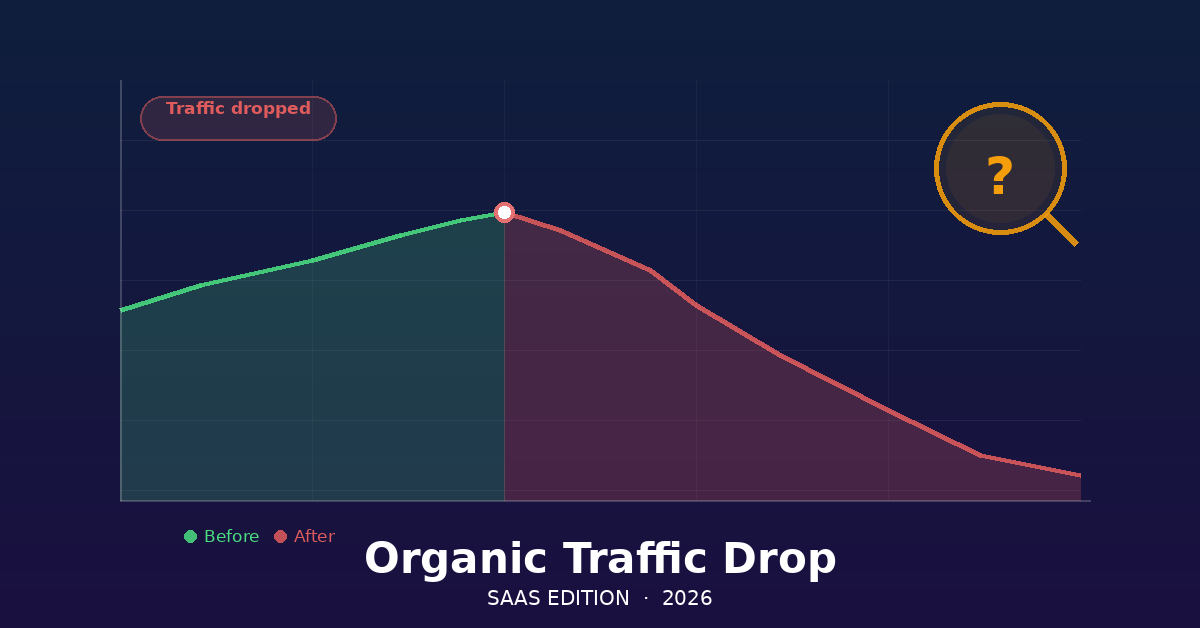
One question in your mind right now as you’re reading this is: “Why is my organic traffic dropping?” — or more specifically, “What are the reasons for a slight or major organic traffic drop for SaaS companies?”
That’s the question this article will help you answer.
Imagine you recently opened your Google Search Console and your eyes widened in alarm because the traffic chart is looking more like a ski slope than a steady climb.
Chances are that the first thing that would pop into your head is this: “Our site tanked… What am I gonna tell the board?”
Now, if this describes the current reality for your SaaS company, I want you to calm down. Take a deep breath before you totally freak out.
The truth is that organic traffic drops in SaaS are pretty common. Although they hurt, most of the time, there’s a pretty straightforward fix once you figure out what went wrong.
This is exactly what this article aims to do.
Through it, I’ll walk you through the most common reasons for SaaS organic traffic declining, what they look like in your data. And most importantly, you’ll discover what you can do about them to recover your rankings and get back on track.
Four Things to Check Before You Diagnose an Organic Traffic Drop
It’s tempting to want to go to your website backend and start changing your content once you notice a nosedive in your traffic.
But you know what? You shouldn’t even think about touching your content until you’ve checked these four things you’re about to discover in a moment.
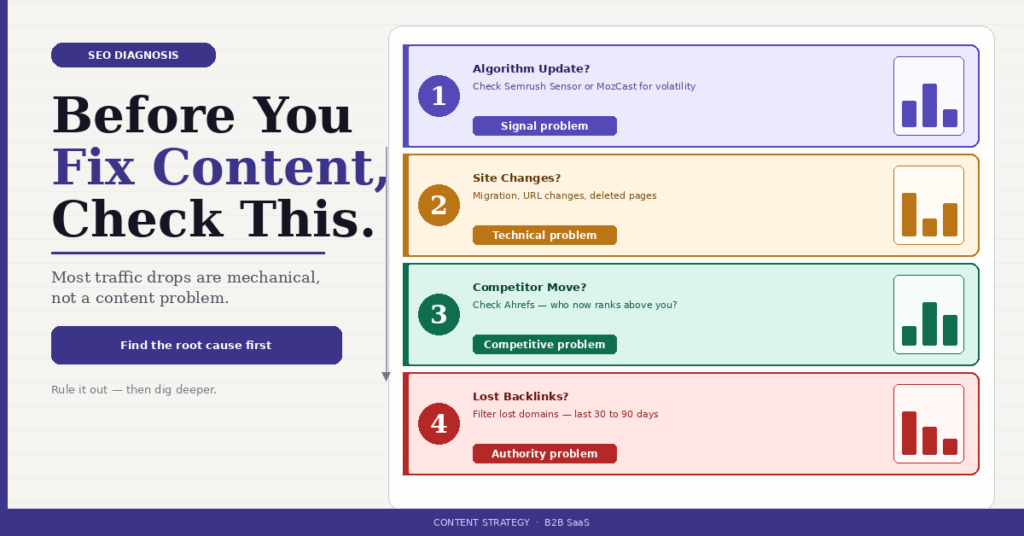
Doing this is important because most organic traffic drops are caused by something a little more mechanical. The more reason you should find the root cause first.
Four questions to ask and answer:
1. Did Google update its algorithm?
Algorithm updates often result in changes in SERPs and a sudden drop in organic traffic for most businesses (including SaaS). To check if this is the reason for the significant drop in your traffic, you need to fire up Semrush Sensor or MozCast.
For instance, if volatility is high around the time your traffic tanked, it could indicate that Google pushed an update. In this case, note that this isn’t a content problem but a signal problem.
2. Did you recently make some changes to the site?
These are critical questions you need to answer if you observed a sharp organic traffic drop:
- Did you migrate to a new domain?
- Relaunched the whole thing?
- Changed your URL structure?
- Removed some pages?
In practice, any of those things can just wipe traffic out, fast. The reality is that SaaS companies are pretty fragile when it comes to technical SEO, especially during a transition.
For instance, if you mess up that redirect map, you might as well kiss months of link equity goodbye.
3. Did a competitor just make a big move?
In the game of SEO, competition can become fiercer. This makes this question normal. One way to discover this is to use tools like Ahrefs or Semrush to take a look at the domains that are ranking above you for your top 10 keywords.
Could it be that some new player just stepped into the game? Or did an existing competitor recently drop a major content bomb?
Now here’s the truth: sometimes organic traffic declining has a lot less to do with what you did wrong and everything to do with what your competition is up to.
4. Did you just lose a bunch of backlinks?
Take a look at your backlink profile using SEO tools such as Ahrefs, SEMrush, and the like. With any of these tools, you can filter for “lost links” in the last 30 to 90 days.
Here’s something to pay attention to: if you just lost a bunch of referring domains, that’s gonna push your rankings down fast, especially for competitive keywords.
Now, you know what?
After carefully answering those four questions, rule out possible situations or confirm they are the cause, the next thing to do is to start digging deeper.
8 Most Common Reasons for Organic Traffic Declining in SaaS
1. Google’s Helpful Content Update Caught Up With You
Google’s goal with its Helpful Content System is to target content that’s written for search engines rather than actual people.
This explains why brands that went down the route of churning out loads of 3,000-word articles stuffed with keywords but not much genuine insight got a big hit (and still do!).
As a SaaS founder or CMO, chances are that this update probably had a pretty harsh impact on your traffic.
Now the question is:
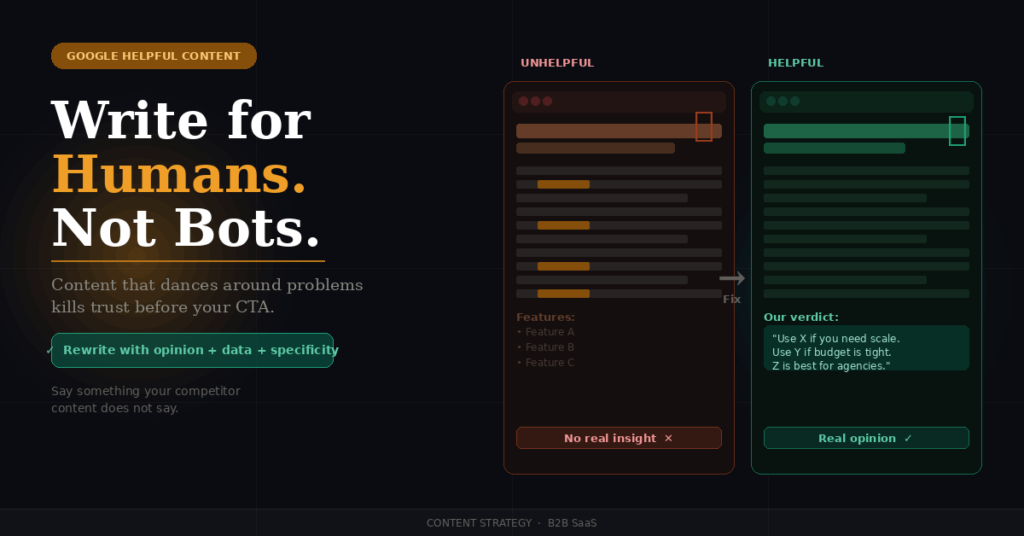
What does ‘unhelpful’ content actually look like for SaaS businesses?
These are those articles that somehow manage to tell you what a term means, but just don’t bother to explain why it’s worth knowing to your specific buyer.
It also includes blog posts that mention a product’s features, but can’t seem to tell you how those features actually make a difference in a business context.
But that’s not all.
You know those “comparison” pages that list ten options but never, ever give you a genuine recommendation. They fall under “unhelpful” content.
Also, content that just copies the same format as the top-ranking page, but offers absolutely nothing new.
How do you check if this might be your problem?
It’s not as difficult as you may think. First, you need to take a look at your five biggest traffic losers.
Read ’em out loud. Then ask yourself this question: if I were a B2B founder looking for an answer, would this page actually give me something useful to help me make a decision?
Now, if your answer to that question is menacing NO, you might just have found your problem.
Here’s the fascinating part: the fix isn’t to just bin it all and start again. No! On the contrary, it’s to go back and rewrite with real opinion, actual data, and specificity.
You know what? A good rule of thumb is that your content should say something your competitor’s content doesn’t say. Simply put, it should be unique.
This ties back to a bigger issue that SaaS companies often have to deal with. A lot of the time, content just doesn’t convert because it dances around the problem rather than actually solving it.
And that kills trust before the reader even gets to your CTA.
2. Your Target Content Misses The Mark on Search Intent
Search intent is the reason someone typed a question into Google in the first place. If you get this wrong, it’s one of the key reasons why organic traffic drops — and Google won’t reward you, no matter how good your writing is.
Take a real-life example. Say you sell project management software to agencies, and you’ve just published a long article targeting the keyword “project management tips”.
If you take a look at the top Google results for that keyword, you’ll see they’re all listicles aimed at students and freelancers, not operations directors at large agencies.
That says a lot about the intent behind that query. The point is that if your article misses that mark— fails to satisfy this intent— Google will punish you by burying it.
It’s that simple.

That said, there are actually 4 types of search intent:
Informational:
As its name implies, this is the search intent whereby a searcher is looking to learn something new, such as what SaaS churn is.
Navigational:
This is the intent behind a search a person makes when he/she is looking for a specific brand or webpage. A good example would be trying to get to the HubSpot login page. In this case, you type “HubSpot login” in the Google search bar.
Commercial:
This is when someone is comparing different options. A practical example would be a B2B team leader trying to figure out which CRM is best for B2B SaaS.
Transactional:
This is when someone is pretty much ready to buy or sign up. A typical example would be trying HubSpot for free.
The bottom line?
In B2B SaaS, you need to have content that covers all four types. But most SaaS companies just focus on the informational content and wonder why their educational blog posts never seem to drive any pipeline.
The truth? Those types of converters were never designed to convert.
However, here’s the fix: before you write a single word, open up an incognito window and search your target keyword.
Take a look at the first 5 results. Ask and answer these questions:
- What format are they?
- What angle are they taking?
- What is it that the reader is clearly looking for?
The insights you gather from trying to answer these questions will help you write content that does a better job of satisfying that intent than what’s already out there.
This is why doing good keyword research for B2B SaaS isn’t only about paying attention to the search volume of terms. It’s about getting inside your buyer’s head and understanding what they’re trying to accomplish when they type a query.
3. Technical SEO Problems That Cause a Sudden Drop in Organic Traffic
You don’t always spot technical issues right away. They can be sneaky & creep up on you, and slowly drain your website’s traffic.
Here are the technical issues most likely to cause a sudden drop in organic traffic for a SaaS company:
Wasting Crawl Budget.
You probably have a ton of thin or duplicate pages out there (especially if you’re a SaaS app that generates unique URLs for each user or project). Guess what? This forces Google to waste its crawl budget on junk pages and ignore the important ones. You can check this on your Google Search Console’s Coverage report.
Failing Core Web Vitals.
Google uses page experience as a ranking factor. This means that if your SaaS marketing site is slow to load, shifts around while loading, or takes a while to respond to clicks, you’re losing ground to your faster competitors.
The interesting thing is that you can check your CWV scores in your Search Console under “Experience”.
Internal Links That Are Dead Ends.
Every time Google crawls your site, it follows internal links to find content. But when it hits a broken link, it’s a dead end. And dead ends mean less content gets crawled, less content gets indexed, and less traffic comes your way.
Noindex Tags By Accident.
This one sounds simple, but it happens more often than you’d think. A developer makes a change, and suddenly, “no index tags” are on the wrong pages.
The outcome? Your organic traffic drops. Fortunately, you can discover pages falling out of the index through your Search Console. This is why it’s good to always check this out after a site change, because it’s a pretty clear sign of a significant drop in your SaaS traffic.
Canonical Tag Mess-Ups.
If your canonical tags are pointing to the wrong pages, you’re splitting link authority and confusing Google about which page to rank.
The sad part is that none of these things show up in your analytics until the damage is done. This is why it’s great to run a full crawl with SEO tools like Screaming Frog or Sitebulb every 3 months. Of course, you don’t have to wait for traffic to drop before taking action.
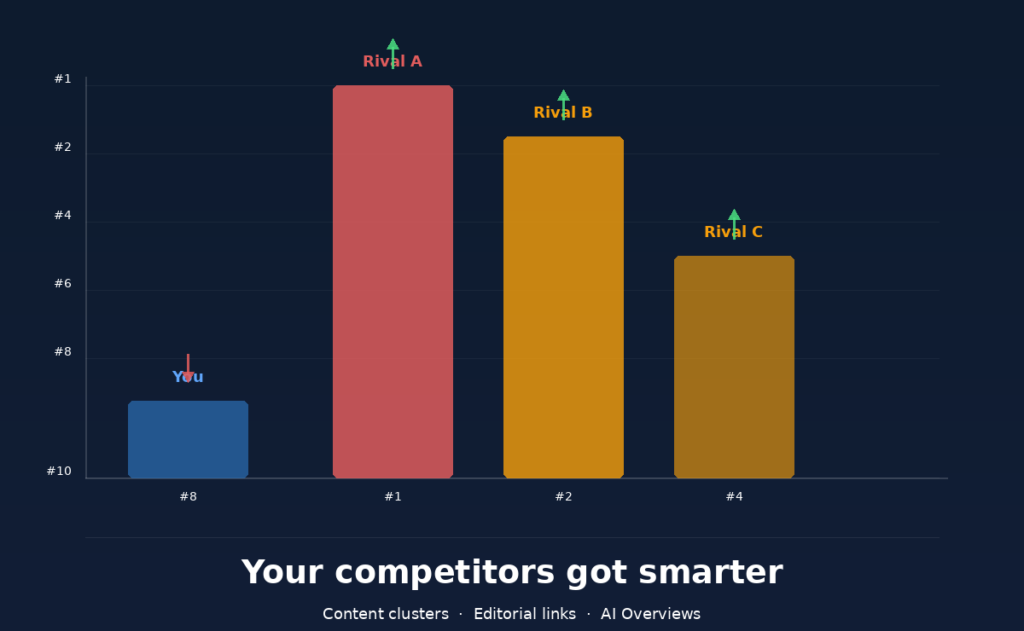
4. Your Competitors Have Suddenly Gotten a Whole Lot Smarter About SEO
Sometimes your rankings drop not because you did anything wrong, but because your competitors figured out something new.
In B2B SaaS, the SEO competition has gotten a whole lot fiercer in the last few years. A few years ago, you could rank for mid-level keywords with a decent blog post and a couple of backlinks.
Nowadays, you’d notice things have changed. Your competitors are building content clusters, earning real editorial links, and optimising for “AI Overviews.” And in some cases, they’re running full-on programmable SEO operations.
Now here’s the question to ponder over:
How do you know if a competitor surge is to blame for your organic traffic drop?
That’s where tools like SEMrush or Ahrefs come in. In any of them, you can head to the “Position Changes” report for your domain. Then find the keywords where your rankings dropped.
After which, you can then search those keywords and see who moved up. Now, if the same 3 competitors show up across 30 different keywords you were ranking for, it’s critical to note that you’ve got a content competition problem on your hands.
This is why many SaaS founders are wondering whether to handle SEO in-house or bring in some outside expertise.
Now, the answer depends on your resources and how fast the competitive landscape is moving. But if you’re consistently losing ground, it’s time for a chat about your strategy.
5. A Damaged Backlink Profile Can Cause Your Organic Traffic to Decrease
Backlinks are one of the things that make Google love your site. Or at least they used to. The thing is, if you lose too many of them, your organic traffic starts to decrease — and your rankings tank with it.
In SaaS, backlinks keep disappearing for all sorts of reasons. It could be that:
- A site that linked to you went dark or yanked the article
- A partner changed their site and somehow managed to lose all the links to you
- You got rid of a resource page or tool that had been earning you links over time
- Your competitors were somehow able to snag more links, and now you’ve got lower authority
This is why it’s essential to regularly check your lost links, not just once a year.
You can log on to Ahrefs or SEMrush and head to “Backlinks”, then filter for “Lost”. Then you can have a look at the domain rating of the pages that dropped the link.
It’s probably a handful of high-DR links that’s behind the drop in traffic you’re seeing.
Now, here’s the fix, in two steps.
The first one is to see if you can get some of those lost links back by reaching out to the people who initially linked to you. For instance, if a link got broken because a page moved, you can ask them to update the URL.
But that’s not all. You also need to have an active link-building program so that you’re constantly earning new links to replace the ones you’re losing.
6. Your Keyword Targets Are All Wrong
This is a sneaky problem. Your traffic might be fine. It might even be growing. But at the same time, your pipeline is flat or shrinking.
And guess what? The problem is not that you’re losing the right traffic. Rather, the issue is that you’ve been attracting the wrong traffic all along.
You’re only just now measuring it closely enough to realise what’s going on.
Unfortunately, SaaS companies get caught up in this all the time. They write content for anyone and everyone because the search volume on those broad keywords is just so high. They rank, get traffic… but none of those visitors are actually B2B buyers.
Often, they’re students, freelancers, or people looking for freebies.
And that’s why you’ve got high customer acquisition costs in your SaaS business. This is one of the most overlooked answers to the question of how to diagnose a drop in leads for SaaS — you’re not always losing traffic, you’re just attracting the wrong kind. It’s all down to SEO.
The point is that you’re spending money on content and earning traffic, but converting almost none of it into a pipeline. And yes, it looks like the economics are broken. But the real problem is the keyword you’re targeting.
With this in mind, you can audit your top 20 traffic pages.
Beyond this, you can use Google Analytics 4 to see what those visitors are doing after they land on your site.
Could it be that they are visiting your pricing page or starting a trial? Or are they just bouncing right back out again?
The bottom line is that pages that get a lot of traffic but don’t have many downstream engagements are targeting the wrong audience.
At this point, you’ve got to ask yourself, would a B2B director even be searching for that keyword? If your answer is “no,” then it’s time to rethink whether you’re targeting it at all.
7. Your Content is Getting Old, and Google Won’t Let You Forget
Google still prefers fresh content for certain searches, and this is one of the quieter reasons why organic traffic declines for SaaS companies — especially for time-sensitive content types. This is why you should focus on comparison content like “HubSpot vs Salesforce in 2026.”
You can also create list-style posts like “best onboarding tools for SaaS.”
At the same time, cover trends like “how SaaS pricing models are changing.” Above all, you should not forget to publish content on stats, data, and the current state of the market.
A Practical Analogy
Suppose you published a comparison article in 2022 and haven’t updated it since. You’re now putting that four-year-old content against pages updated in 2025 or even 2026.
Which of the content do you think would win? Undoubtedly, the answer would be the up-to-date page.
This is true because you can’t just add a “Last Updated” box and call it done. Google can tell the difference between surface edits and real updates that improve the content.
A real update to content would mean revisiting every claim it contains, swapping out old tools for new ones, ensuring stats are up to date, and rewriting sections that are no longer relevant.
The goal is to set up a content refresh calendar to help stay on top of updates. You know what? This helps you sort your content by how poorly it performs in traffic. Only then can you focus first on pages that used to rank but have dropped off.
The point is that updating an existing page is way faster than writing brand new content. In short, you might see your ranking come back quicker than it will take for entirely new content to rank.
8. AI Overviews Are Stealing Your Clicks
This is the biggest reason why organic traffic is dropping in 2026 — and it’s only going to get more significant.
Google has been showing AI-made summaries at the top of search results for loads more and loads more queries. Essentially, those summaries do the user’s job for them by answering the question before they even click on anything.
So the reality is that now you’re ranking, but nobody’s actually clicking through.
But the question is, how can you tell if this is the reason for the drop in your SaaS traffic?
Take a look at your Google Search Console data. If impressions are steady or even growing, but your click-through rates are tanking, it’s a safe bet that AI Overviews are the culprit.
That said, the long-term fix is to produce content that can’t just be summarized into three sentences by a machine. This means you’re after content that’s built around:
- First-hand experience and real case studies
- Your own proprietary data and research
- Opinionated frameworks that are specific to your way of doing things
- Deep product-led content that shows your tool actually solving a real problem
This is where product-led SEO comes in handy. When your content is based on how your product solves real problems and what real people get out of it, it’s a lot harder for anyone to turn it into generic content and more likely to get people going straight to your site with direct intent.
How to Recover Rankings After Diagnosing Your Organic Traffic Drop
Finding the cause is only half the battle. The other half is making the fixes without making things worse.
Here’s the basic diagnostic sequence for how to recover rankings after an organic traffic drop:
Run a technical audit first.
This will allow you to sort out crawl errors, indexing issues, and speed problems before you even think about touching content. This is critical because a shaky foundation is nothing without solid content.
Audit your top 20 traffic-losing pages.
For each of these pages, work out what went wrong. Was it an intent mismatch, sub-standard content, outdated, or irrelevant keywords? The idea is to pin down one main problem per page.
Prioritise where it counts.
Tackle pages that were ranking between positions 4 and 20 first because these are your fastest wins. On the other hand, those below 30 often need a complete rethink of the keyword target or a full rewrite.
Get your internal links sorted
A strong internal linking structure helps Google see your content hierarchy and gets your authority spreading across the site. This is especially important if you are running content clusters.
Note that each cluster page should connect back to your pillar content.
Give it 90 days and then take stock
SEO changes don’t happen overnight. You can set a 3-month window and track weekly changes in Search Console or premium tools such as SEMrush or Ahrefs to see what works.
The bigger picture
Many SaaS founders get hung up on organic traffic, as though it is the one metric that matters. But in reality, it’s not.
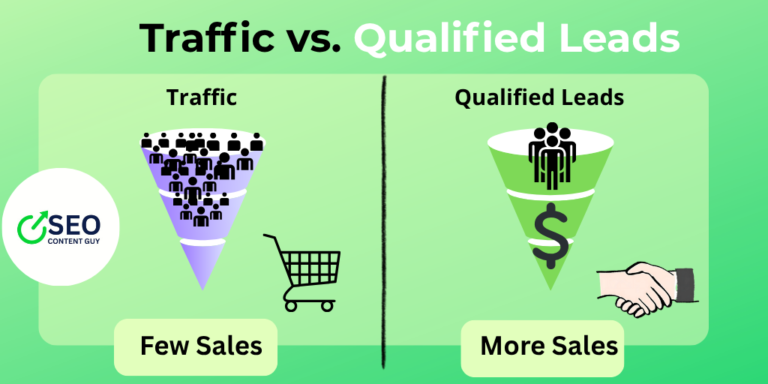
The truth? Traffic that doesn’t turn into sales is just a vanity number. For instance, you can get 40% more traffic, but if your qualified leads are staying flat, it raises this question: what’s the point?
That’s why understanding why organic traffic drops — and fixing it — should always start with a full-funnel strategy, not just a content calendar. This way, SEO can drive your pipeline. But it would only happen when you choose the right keywords, formats, and internal links that guide buyers at every stage of the funnel. This goes beyond chasing high search volume in a spreadsheet.