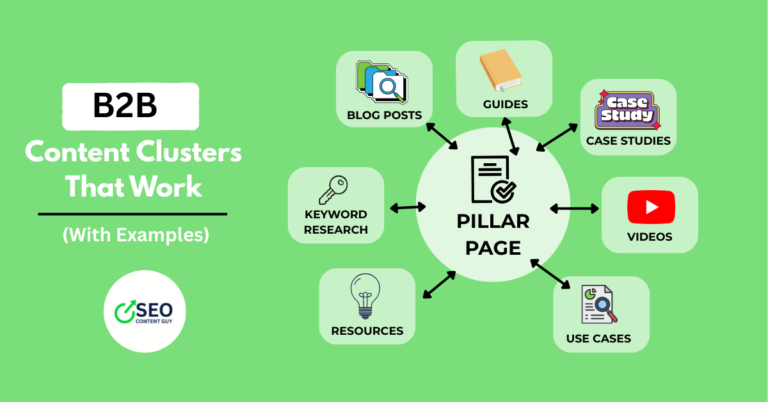

You might find it easy to understand the theory behind B2B content clusters. Applying it to build a real content cluster for a real company is where most people get stuck.
That’s the challenge this article addresses by breaking down six content cluster examples from brands that have made it work. You will see the actual pillar page, the cluster posts around it, how the internal links flow, and what each brand gained from the structure.
This article assumes that you already have a foundational knowledge of how B2B content clusters work. That’s to say, you already know the concept and want to see it in action.
Three of the six brands in this article are B2B companies. The reason for this choice is that most content cluster examples focus on lifestyle or e-commerce brands. As a founder or CMO looking to build topical authority in a complex category, these B2B examples are more relevant.
Pro tip: Here are what you should look for in each example: the pillar topic, the cluster posts around it, how they link to each other, and what made the structure work. Each one teaches a different lesson.
HubSpot | B2B SaaS / Marketing | Pillar: “Inbound Marketing” guide
HubSpot: The Brand That Invented the Playbook
HubSpot did not just use the pillar-cluster model. They published research that named it. In 2017, their SEO team formally documented the model and rebuilt the entire blog around it. That makes HubSpot the most studied example in this category.
The pillar page
HubSpot’s inbound marketing pillar page is a long-form guide that covers the full concept. It provides an overview of inbound marketing, how it works across stages, why it is important, how inbound marketing works, and its automation.
The page doesn’t go deep into any single subtopic. It introduces each one and links to the supporting cluster content.
The cluster posts include:
- How to Create Great Content: Tips from a Content Marketer
- How to Create an SEO Strategy [Template Included]
- Solution selling: What it is and how I do it effectively
- How HubSpot Personalized Our Chatbots to Improve The Customer Experience and Support Our Sales Team
- 23 Excellent Customer Satisfaction Survey Examples [+ Templates]
- What Is Social Media Listening & Why Is It Important? [+Expert Tips]
How the internal links work
Every cluster post links back to the inbound marketing pillar using anchor text that matches the pillar’s target keyword. The pillar page links to every cluster post in the section where it introduces that subtopic. This is bidirectional linking done correctly. The cluster post gets authority from the pillar. The pillar gets relevance reinforcement from the cluster.
HubSpot also cross-linked cluster posts whenever one subtopic naturally led to another. A reader in the email marketing cluster post who wants to understand lead generation finds a contextual link to that cluster post inside the body of the article, not just in a sidebar.
What made it work
Scale and consistency drove HubSpot’s success. They reorganized their entire blog into topic clusters. HubSpot grouped thousands of existing posts around core pillar topics. This, in turn, eliminated keyword cannibalization and concentrated authority on its pillar pages.
That made Google recognize HubSpot as an authoritative source on inbound marketing.
Ahrefs | B2B SaaS / SEO Tools | Pillar: “SEO” guide
Ahrefs: The Cluster That Earns Its Own Backlinks
Ahrefs built its content cluster around the broadest possible pillar in its category: SEO itself. Every major subtopic inside SEO became a cluster post. The result is one of the most densely interlinked content systems in the SEO tool market.
The pillar page
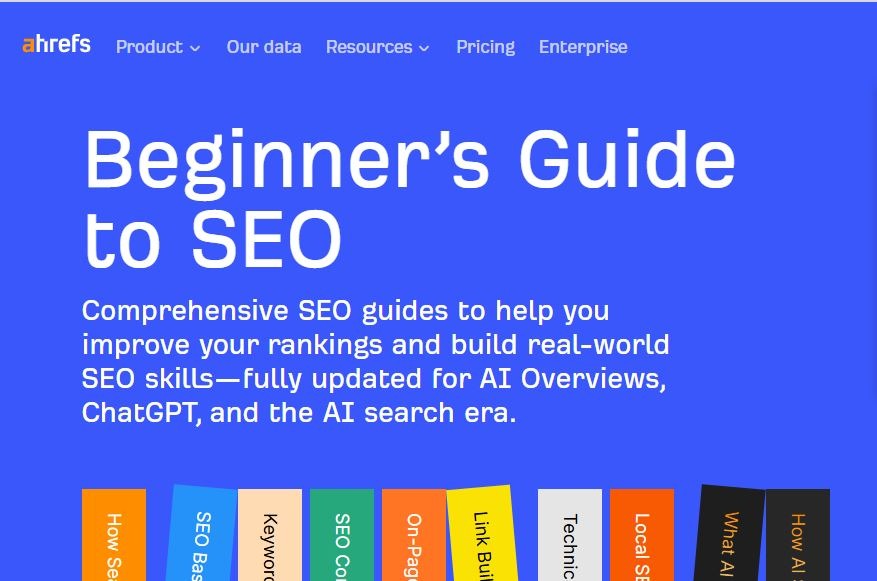
Their SEO pillar page covers what SEO is, why it matters, how search engines work, and the major practice areas. It functions as a map of their entire content cluster. Every section is a doorway into a deeper cluster post.
The cluster posts
- How Search Engines Work
- SEO Basics: Beginner’s Guide to SEO Success
- How to Do Keyword Research for SEO (Start to Finish)
- SEO Content: The Beginner’s Guide
- On-Page SEO: How to Optimize for Robots and Readers
- Link Building for SEO: The Beginner’s Guide
- The Beginner’s Guide to Technical SEO
- Local SEO: The Complete Guide
- What AI Means for SEO
- How AI Search Engines Work
How the internal links work
Ahrefs links cluster posts to each other, not just back to the pillar. This way, a reader in the keyword research cluster post will find contextual links to the on-page SEO and technical SEO cluster posts at the exact moment those topics become relevant in the text. In turn, this creates a web of links, not a simple hub-and-spoke.
But most teams miss that step when they start building content clusters. They link each cluster post back to the pillar page and stop there.
Ahrefs shows that sideways links between cluster posts, placed contextually and with descriptive anchor text, strengthen the whole cluster.
This is the exact approach we cover in our “How to Cluster Your Keywords” guide.
What made it work
At the top of the list of what makes Ahrefs’ content clusters work is Original data. Yes, they publish findings from their own database inside their cluster posts.
These include studies on keyword difficulty, backlink patterns, and ranking timelines that only they can produce. The good thing about this is that those posts earn external backlinks from other sites that cite the data.
Here’s what matters: every external backlink to a cluster post passes authority to the pillar page. This means each cluster post builds its own link equity as it earns backlinks without relying on the pillar to distribute authority.
Gong | B2B SaaS / Revenue Intelligence | Pillar: “Sales” and “Revenue Intelligence” guides
Gong: The B2B Cluster That Uses Its Own Data as the Differentiator
Gong is one of the clearest examples of a B2B content cluster for founders and CMOs. Their strategy is built entirely around proprietary data.
The interesting part is that their cluster posts are not articles revolving around sales. They present findings from millions of analyzed sales calls, attributed to Gong Labs, their internal research team.
The pillar pages
Gong has multiple pillar pages across their site, covering sales forecasting, sales coaching, revenue intelligence, and ideal customer profiles.
An analysis of their traffic data noted that “Everything you need to know about ICP in sales” is their second-highest-traffic page. This page serves as a pillar with cluster posts covering specific ICP-related subtopics that link back to it.
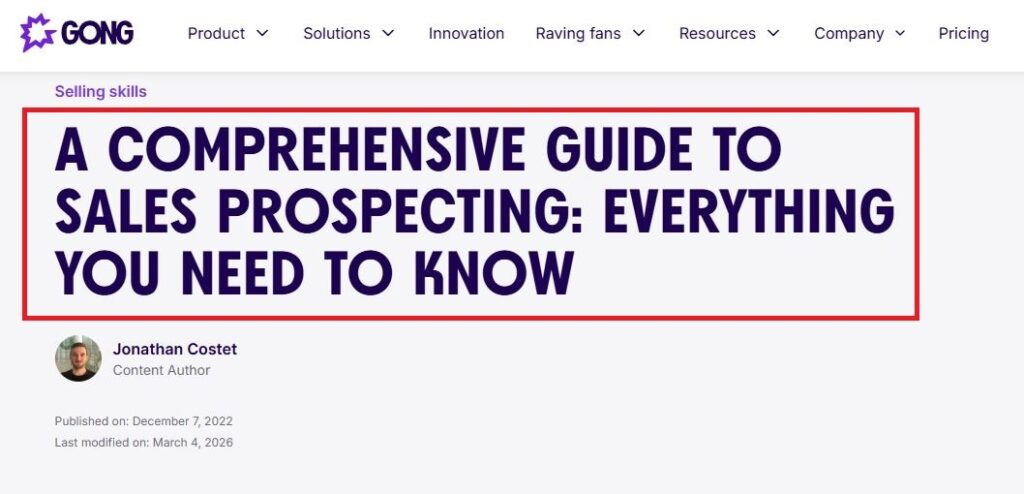
A good post example that demonstrated the cluster-pillar model is the one titled “A comprehensive guide to sales prospecting: everything you need to know.”
The cluster posts cover these:
- Cold calling is’t need dead: Proven strategies that book more meetings
- Book more meetings with 13 proven sales prospecting techniques
- Essential cold calling tips: 17 proven techniques for success
- What is an ICP for Sales? Everything You Need to Know
- Mastering the BANT framework for sales success
- Sales pitch examples: 5 elements that help you win
- There’s a science to writing sales emails: What the data REALLY says
- 3 powerful tactics to build rapport in sales
How the internal links work
Gong links cluster posts to pillar pages using anchor text that exactly matches the pillar topic. They also gate some of their deepest resources, templates, and research reports, as downloads linked from within cluster posts.
For instance, a reader who follows a cluster post about ICP to its conclusion may find a download for an ICP template. And that download is on its own landing page, which also links back to the pillar.
What made it work
Nobody else has their data. Gong’s proprietary sales-call research gives its content cluster a unique advantage.
In one study of 25,537 sales calls, Gong found that the highest-performing B2B sales conversations had a 43:57 talk-to-listen ratio, and Gong says its broader insights are based on millions of sales interactions.
That original research also attracts backlinks. Other sites cite Gong’s findings and link back to its content, making original data a built-in link-building engine.
Salesforce | B2B SaaS / CRM | Pillar: “CRM” and “Customer 360” guides
Salesforce: The Cluster Built Around Buyer Education, Not Rankings
Salesforce does not need content to rank for “CRM software.” And that’s because they are the market leader.
However, Salesforce still invests heavily in content clusters for a different reason than most brands. It uses them to educate buyers long before they’re ready to purchase.
The point is that Salesforce keeps its brand top of mind during every stage of a long B2B buying journey by answering questions throughout the research process.
startup
The pillar page
Its goal is to be the most useful resource for someone researching CRM, not to convert them on the first visit.
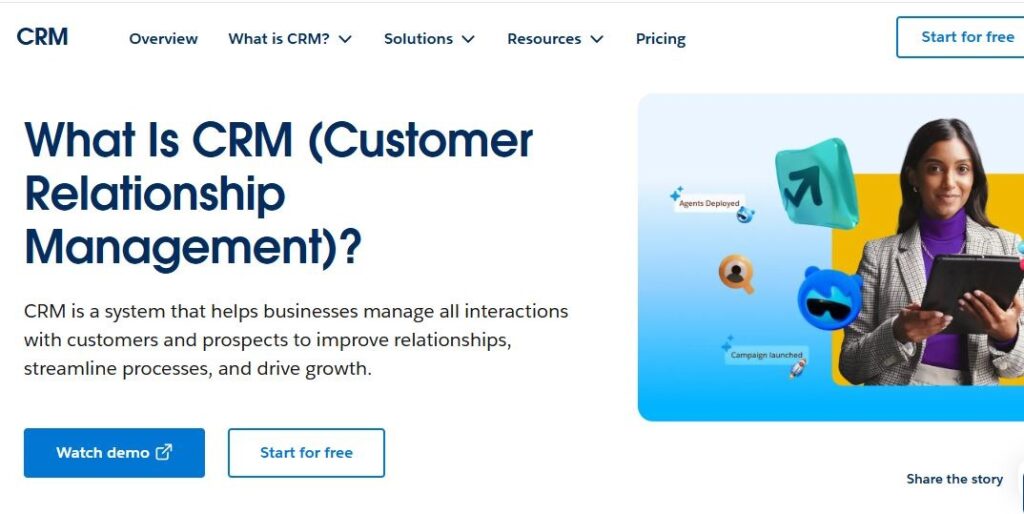
Their CRM pillar page is a comprehensive resource titled “What is CRM?”
This page defines CRM software, explains how it works, and covers related topics. Salesforce satisfied the intent of the page without forcefully promoting its product on the page
The cluster posts include:
- What Is CRM Software? A Comprehensive Guide
- 5 CRM Examples That Will Inspire Any Team
- A Beginner’s Guide to CRM Systems
- The CRM for small businesses with great ambition.
- What Is a CRM Database? (A Comprehensive Guide)
- The 11 Greatest Benefits of CRM Platforms
- Create a Custom CRM: Your Complete Guide
- What is CRM Reporting?
- CRM Implementation: A Comprehensive 9 Step Guide
How the internal links work
Salesforce maps its cluster to the buyer journey. The pillar page targets the awareness stage, while cluster posts like “CRM for Small Business” target buyers in the consideration stage who are deciding whether they need a CRM.
Other cluster posts like “CRM implementation” serve buyers who have decided to buy and are evaluating execution risk. Yet the idea is that each cluster post links back to the pillar and forward to the next logical step in the journey.
What made it work
The separation of education from conversion. Salesforce built a cluster that genuinely helps buyers understand CRM without making every page a product pitch.
That approach earns trust during the research phase. And by the time prospective buyers reach the bottom of the funnel, they have already spent multiple sessions reading Salesforce content. At that point, the buying decision feels natural and familiar, not cold.
Shopify | B2C / Ecommerce Platform | Pillar: “Dropshipping” guide
Shopify: The Cluster That Converts Traffic into Free Trials
Shopify’s dropshipping cluster is one of the most commercially effective content cluster examples available. And that’s because it is built with conversion in mind from the first post to the last.
Every cluster post includes a CTA to start a free Shopify trial. The educational content and the commercial goal are unified, not separate.
The pillar page
For instance, their dropshipping pillar page, “What Is Dropshipping and How Does It Work?” covers the business model at a high level. It defines dropshipping, explains the economics, names the main suppliers, and walks through what it takes to get started.
It ranks among the most competitive e-commerce keywords in English.
The cluster posts include:
- How To Start a Dropshipping Business: 9 Essential Steps
- What Is Order Fulfillment? Improve Your Process & Strategy
- Best dropshipping suppliers
- How to find dropshipping products that sell
- Is Dropshipping Worth It
- AliExpress dropshipping: a beginner’s guide
- Dropshipping Products: 150+ Profitable Ideas
How the internal links work
Shopify structures its cluster by buyer stage. A reader at the awareness stage finds the pillar page first.
And yes, the pillar links to “How to start a dropshipping business,” which is the consideration stage post. That post links to “Best dropshipping suppliers,” which is a decision-adjacent post.
You get the point: at every step, there is a free trial CTA. More importantly, the cluster functions as a funnel, not just an information architecture.
What made it work
The reason in a simple sentence is: mapping each cluster post to a stage of the buyer journey, and then placing a consistent CTA at each stage. While most content clusters are built for traffic and rankings, Shopify’s dropshipping cluster is built for trial signups.
Now note that the difference is not in the SEO mechanics. It is in knowing what you want the reader to do next at every step of the cluster.
Semrush | B2B SaaS / SEO Platform | Pillar: “Keyword Research” guide
Semrush: The Cluster That Doubles as a Product Demo
Semrush built a content cluster around keyword research, one of the highest-volume topics in SEO search. But what makes their cluster different is that each cluster post also teaches you how to do the task inside Semrush. (This approach is at the centre of a product-led SEO.)
Simply put, the educational content and the product walkthrough are the same article.

The pillar page
Their keyword research pillar page covers the full process: what keyword research is, why it matters, how to choose the right keywords, and how to structure a keyword strategy. It introduces major subtopics and links to cluster posts for each one.
The cluster posts include:
- Keyword strategy in SEO: What it is & how to create one
- How to find buyer intent keywords for organic & AI search
- How to do keyword research in 2026 (6 ways + framework)
- The Most Searched Things on Google [2026]
- How to find low-competition keywords with Semrush
- Local Keyword Research for SEO: What It Is & How to Do It
- How to use Google Keyword Planner
- What Is Keyword Search Volume? + 5 Free Tools to Check It
- 8 Keyword Research Tools to Try (Free & Paid)
- AI Overviews: What Are They & How to Optimize for Them
How the internal links work
Semrush uses its cluster posts to teach the concept and demonstrate the tool in the same flow. For instance, a reader who lands on “How to do competitor keyword analysis” not only learns the methodology. He also sees a step-by-step walkthrough of the same process inside Semrush.
And yes, the pillar page links to each cluster post. Likewise, each cluster post links back to the pillar and to the Semrush free trial.
What made it work
Combining tool education with content education in a single article removes the gap between learning and trying. This way, a reader does not have to figure out how to use the tool. This is because upon finishing a cluster post, he has already seen the tool in action.
With this approach, each cluster converts readers to users because every cluster post is also a product demo.
What Every Successful Cluster in This List Has in Common
Looking across all six examples, here are four patterns that appear in every cluster that work:
1. The pillar page introduces, not explains
Every pillar page above covers its topic broadly and links out to deeper cluster posts for each subtopic. Similarly, none of them tries to explain everything on the pillar page. So while the pillar is a map, the cluster posts are the territory.
2. Internal links flow in both directions
Each cluster post links back to the pillar, the same way the pillar links out to them. Brands like Ahrefs go further and link cluster posts to each other. This bidirectional structure is what makes the cluster function as a network, not a collection of separate articles.
3. Each cluster post owns exactly one search intent
None of the cluster posts above try to rank for the same query as the pillar page or as each other. While the guide on how to cluster your keywords before you build covers this in detail, here’s the short version: one intent per page. This is why when a cluster post tries to serve two different intents, it ends up not ranking for any.
4. The cluster matches the buyer journey, not just the keyword list
Shopify and Salesforce both show this clearly. They do not build cluster posts based on which keywords have the most search volume. They build cluster posts based on the questions buyers ask at each stage of the decision process. So this truth holds: the keywords follow the journey; the journey does not follow the keywords.
What Does This Mean for Your Blog?
If you are a B2B founder or CMO looking at these examples and thinking about how to build your own cluster, the clearest starting point is choosing one topic your company has genuine depth in.
This is not the broadest possible category, but a topic where you can publish a pillar page and seven to ten cluster posts that each answer a real question your buyers ask.
B2B content cluster strategy covers the full build process, including how to choose your pillar topic and which cluster model fits your business. You can read that and come back to these examples when you want to see how far a cluster can go.
And, in case you are thinking about which tools to use as you build, you can read this article on platforms that support the pillar and cluster model. It compares five platforms by use case so you can match a tool to the stage you are actually in.